
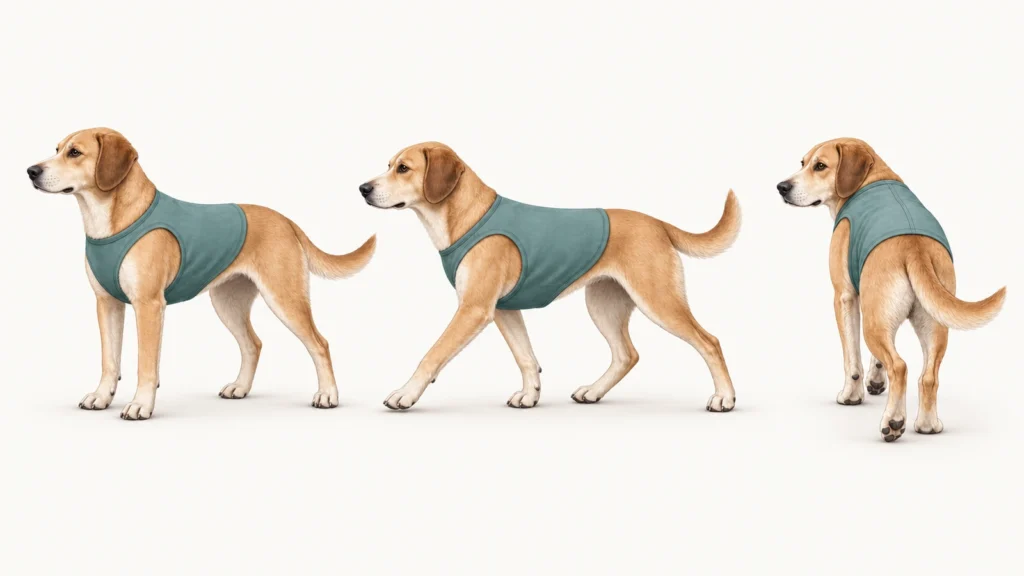
A pet apparel sample should not pass a buyer’s fit review just because it can be put on the dog. Before approving the next development step, look at what happens when the dog moves, whether the intended areas remain covered, and whether openings and closures continue to work. A chest measurement and a standing photograph cannot answer every one of those questions.
The distinction is practical. The RSPCA’s winter coat advice calls for a snug jacket that permits movement. That supports checking movement as well as appearance; it does not establish a veterinary sample-approval procedure. This guide offers a proposed Meetfunpet buyer framework for ordinary dog apparel, with a separate boundary for life jackets.
What Does Fit Testing Mean for a Pet Apparel Buyer?
Here, fit testing means reviewing an identified physical sample on an identified dog against the intended wear conditions, recording observations, and deciding what needs revision or further checking. The output is a specific decision about that sample and the evidence still needed. It is not a comfort diagnosis, laboratory result, or guarantee that every garment in a future order will fit.
Before fitting, use consistent body and garment measurement definitions. Keep the dog’s reference measurements and the sample’s actual measurements separate. This article starts where that preparation ends: examining the garment on the dog. It does not rebuild the size chart or explain how to take each body measurement.
We propose four review areas: static position; movement and stability; functional clearance and closures; and coverage of the intended sizes and body shapes. The last area asks whether development evidence covers the proposed range. It is not a bulk consistency inspection. These areas can be revisited after a change; they are not an industry standard or mandatory production sequence.
What Public Reviews Reveal About the Limits of “Fits”
Public buyer-review observation: In one public review examined during Meetfunpet’s market research, a Spark Paws T-shirt buyer selected “Ok” for fit but described twisting and folding that required repeated repositioning. The same reviewer mentioned two dogs; this remains one review, not two independent tests. The record identifies Blue Mint / 4XL, but provides no review date or comparable body measurements.
This is evidence of what a public buyer reported, not a Meetfunpet customer case or a garment Meetfunpet tested. It illustrates why a broad fit rating deserves follow-up with a description of what the garment actually did. It does not establish how often the problem occurs, whether movement was restricted, or whether sizing, pattern, material, or construction caused it.
In a separate public review examined during the same research, an RC Pets Baseline Fleece owner reported that the dog could urinate without wetting the fleece. The February 6, 2024 report is useful because it names a functional outcome. One owner’s experience does not validate toileting clearance for every dog, size, or product version, and it says nothing about defecation clearance.
Record the Dog, Sample and Intended Use First
Give the fitting a reference that can travel with the feedback: style code, sample version, garment size, dog identifier, date, and reviewer. Add the dog’s current measurements, relevant proportions, and the sample’s material and construction version. Record any substitute fabric, altered closure, or hand adjustment. Do not let an early prototype silently stand in for a materially different later sample.
Write a short description of the intended wear setup. Is this a standalone sweater, a fitted vest, or a raincoat over another layer? Which areas should remain covered? Which harness and leash arrangement is intended? These are product decisions to agree before judging the sample. A vague instruction such as “make it comfortable” leaves the reviewer without an observable target.
Use a familiar handler and let the dog move voluntarily in a suitable, controlled setting. Start with ordinary movement without the sample as a comparison where practical. Keep the session supervised, pause if the dog resists or appears distressed, and do not force a pose to finish a checklist. Unusual movement is a reason to stop and investigate, not enough evidence to diagnose its cause.
Check Static Position Before Asking for Movement
With the dog standing naturally, review both sides, the front, the back, and the accessible underside. Note where the neckline, chest panel, openings, belly edge, and rear hem sit. Compare left and right positioning and the agreed coverage target. Take photographs before straightening anything that has shifted, provided doing so does not prolong a problem for the dog.
Look for fabric visibly pulled across the chest, an opening pressing into the front-leg area, a sleeve already near a paw, a neckline drawn out of position, or a belly panel gathered under a closure. Record these as observations. A wrinkle or taut area alone does not tell you whether the sample needs more width, a different opening position, or a construction correction.
Fasten the sample using its intended adjustment range. Record the setting and whether closing it requires pulling panels out of their intended position. Do not hide an unresolved fit problem with an improvised pin, rolled sleeve, or unusually tightened strap. If you make an exploratory adjustment, label it and keep its result separate from the unmodified sample.
Watch What Changes When the Dog Moves
Use the following observation prompts for actions the dog can comfortably perform. Record both the position during the action and what remains displaced afterward. This is Meetfunpet’s proposed observation checklist; the actions are not a validated canine biomechanics test. A short video should show the transition into and out of the position, rather than only the most flattering moment.

| Action | Observe | Record for follow-up |
|---|---|---|
| Stand | Starting coverage, neckline, chest panel and opening position. | Reference views and closure settings before movement. |
| Walk | Front-leg passage, sleeves near paws, panel movement and any visible change from ordinary walking. | Side and front views; the step where contact, slipping or displacement appears. |
| Turn | Whether the garment rotates, gathers on one side, or draws a closure or neckline sideways. | Direction of the turn and whether the garment returns to position. |
| Sit | Chest and belly folds, rear coverage, closure position, and hind-leg sleeves if present. | Changes while lowering, seated, and returning to standing. |
| Lie down | Where openings and sleeves move as legs fold, and whether panels or fasteners bunch underneath. | The transition and the position after getting up; mark unobserved actions. |
Inspect the Front-Leg Area as a Moving Relationship
Follow the chest panel, shoulder area and front opening together as the leg moves. Note repeated contact, an edge moving into the leg’s path, a paw approaching the inside of a sleeve, or an opening shifting away from its starting position. For garments with hind-leg coverage, make the equivalent observation at the rear. Avoid prescribing a universal anatomical clearance distance.
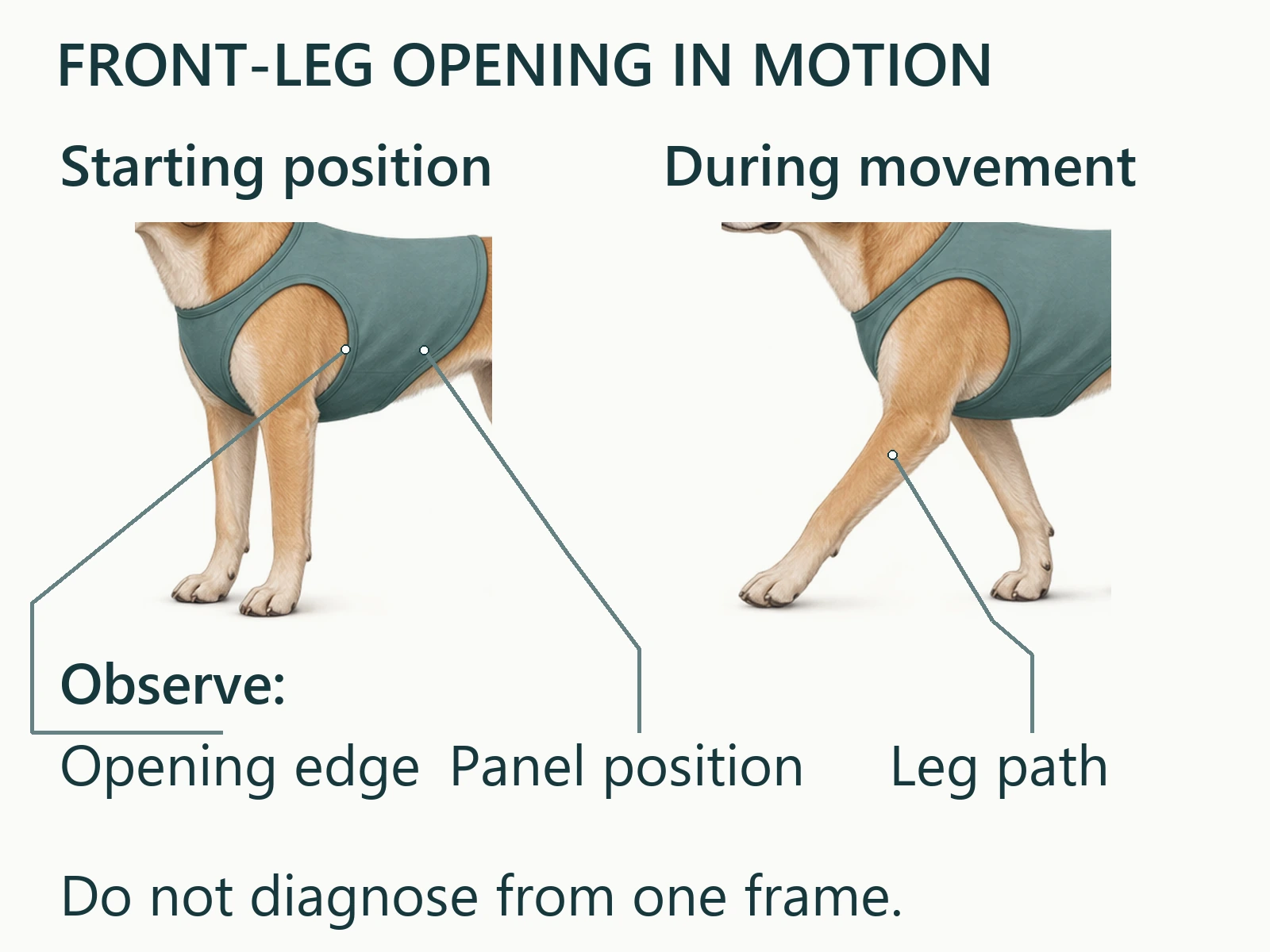
Style-specific construction matters. Hurtta’s Extreme Overall II lists adjustable leg openings with snaps and several body adjustment points. Those are product features, not proof that another overall will move correctly. They suggest asking which parts of your sample are adjustable, and observing each intended setting on the relevant wearer.
Record Shifting Before Trying to Explain It
Use a visible reference such as the centre-back seam or the original hem position to describe displacement. Write “back panel moved right during a left turn” instead of “bad fit.” Record whether it stays displaced, whether a closure loosens, and whether coverage changes. Repeated straightening should become part of the record, rather than disappearing between photographs. Shifting alone does not identify a pattern defect.
Check Clearances, Closures and Coverage Together
Toileting Clearance Is a Separate Observation
Inspect the belly, rear and tail openings in the intended wear arrangement. Where appropriate, have the handler observe normal toileting without forcing or delaying it. Record urination clearance and defecation clearance separately, including garment contact or wetting if observed. Keep the dog’s relevant anatomy and posture with the record. If an outcome was not observed, mark it “not observed” rather than passed.
A generous underside opening or a short standing hem is not sufficient evidence that both functions are clear. Do not create a universal male/female cut line from one dog’s result. If the style requires opening or securing a panel for toileting, include that operation in the review and check the garment again after it is restored to its wearing position.
Use the Intended Harness and Closure Arrangement
Test access using the intended harness, layer order and attachment location. Check whether the opening lines up while standing and moving, and whether reaching the harness pulls the garment sideways. For example, Ruffwear’s Furness jacket specifies a back leash portal for wearing over a harness. That does not make a portal compatible with every harness, or turn it into a load-bearing attachment.
After ordinary movement, revisit each closure. Has hook-and-loop engagement reduced, a strap setting changed, or a panel pulled against a zip? Can the handler deliberately open and refasten it without catching fabric or fur? Record operation and retention separately. These observations support sample revision; they do not establish fastener strength, cycle durability, or the garment’s suitability for restraining a dog.
Compare coverage against the brief after each relevant action. A shifted back panel may leave an intended area exposed, while a revised lower edge may need another clearance check. Ask what moved, where coverage changed, and what was happening at that moment. Treat added coverage and usable clearance as requirements to review together, rather than assuming a longer garment is always better.
Adjust the Review to the Style
Ruffwear’s apparel fit guide distinguishes sleeveless vests, jackets with sleeves, and coveralls, and discusses fit choices for different builds. This is guidance about its own range. It supports asking style-specific questions; it does not establish that one silhouette is best for every dog.
- Hoodies and sweaters: follow the front openings, cuffs and body position through transitions. If a hood is intended to be worn up, review that configuration separately for head movement and unobstructed vision. Record whether stretching or an adjustment was needed to achieve the photographed position.
- Jackets, raincoats and fitted vests: focus on the chest-to-belly panel, intended coverage, closure settings and harness access. For sleeveless styles, still observe the panel edge beside the front legs. For sleeves or overalls, add the relevant leg transitions. Check planned layering as its own configuration.
- Life jackets: keep dry-land fitting within a separate product-development plan. Ruffwear describes its life jackets in terms of swimming movement and buoyancy in its product FAQ. A standing or walking check supplies neither flotation performance nor water-safety validation. Resolve those requirements with appropriate product specialists; this guide is not an in-water test procedure.
Decide What to Investigate Before Requesting a Revision
Human-apparel development offers a useful distinction: Techpacker’s fitting guide separates sample measurements, pattern and construction review, movement observation, and documented changes. These principles can inform a pet-apparel discussion, but the human fitting method is not a validated dog protocol.
Use the observation to choose a question for the developer. The following are investigation routes, not diagnoses or automatic corrections:
- Size reassignment: investigate when the dog’s recorded dimensions fall outside the proposed range, or another existing size is a plausible candidate. Physically check the alternative; a change of label alone does not resolve wear behavior.
- Measurement adjustment: investigate when the actual sample differs from the requested specification, or an agreed dimension needs reconsideration after fitting. Distinguish correcting a sample to the existing brief from changing the brief itself.
- Pattern or proportion change: investigate when local positioning remains unsuitable despite the relevant dimensions matching the brief, or changing size creates a different problem elsewhere. Ask the developer to examine opening position and panel relationships.
- Closure or construction adjustment: investigate when the observed issue centres on fastening position, engagement or assembly. Recheck the surrounding fit after any correction.
- Style or material revision: investigate when the intended layering, hood, sleeve or coverage arrangement remains unresolved. Treat a fabric substitution as a changed sample configuration requiring its own review.
An Illustrative Hoodie Observation
Illustrative only — not a Meetfunpet client case. Imagine a hoodie that looks acceptable while standing. During walking, a front leg approaches the armhole edge and the body moves sideways. Record the action and location before calling it “runs small” or “runs large.”
The developer could investigate size choice, opening position, panel width or proportions, and the material used. These are competing hypotheses, not established causes. Request a documented change and a repeat observation of the relevant movement. No successful correction, injury, or customer outcome is assumed in this example.
Document the Issue So the Next Sample Can Answer It
Keep one issue entry for each distinct observation, linked to the fitting reference. Include the action, location, photo or video filename and timestamp, adjustment setting, and the difference from the intended result. Separate the observed behavior from the proposed explanation, requested change, person responsible, and status. Mark missing views and unobserved functions explicitly.
Photos should establish the starting position and show the issue from a useful angle. Short videos should preserve the relevant transition. Retain the original record alongside annotated copies, and identify later sample versions consistently. Connect agreed revisions to the current reference sample and technical specification so the next review uses the same development instructions.
What Counts as Evidence That the Issue Is Resolved?
For this proposed workflow, close an issue only after the identified revised sample has been reviewed against the requested change, the original problem action has been checked again, and connected coverage, clearance and closure questions have been revisited. Record the result, reviewer and limits of the observation. A supplier’s assurance or a new standing photo alone does not close a movement-related issue.
Where practical, repeat the check with the original dog and setup to make the comparison clearer. If the dog, size, material, harness or other relevant condition changes, state that difference and its effect on what can be compared. Use “not observed in this repeat check” when that is what the evidence supports; avoid “fixed for all dogs.”
How Far Does the Fit Decision Extend?
A successful check supports only the recorded sample and conditions. One dog, one breed, one size, or one successful session cannot establish the whole proposed range. Plan additional fittings when intended body proportions, size transitions, materials or constructions remain unrepresented. Select them to answer the outstanding question, not to satisfy an invented universal test-dog count.
For example, if feedback raises a long-body coverage question, another dog with an already-reviewed proportion may leave that question unanswered. Likewise, reviewing one middle size leaves other proposed sizes unobserved. Keep a simple coverage list showing what has been checked and what remains open. This is development evidence planning, not a sampling plan for bulk inspection.
Before moving forward, record the exact sample version, accepted configuration, unresolved items, and next authorized step. “Suitable to continue development for the reviewed setup” and “fit approved for the documented scope” are different decisions. Neither promises bulk consistency. Keep production inspection and performance verification as their own decisions.
Turn Fit Observations Into a Clear Development Brief
Meetfunpet supports pet apparel development and manufacturing in China, from product requirements and sampling to private label and production follow-up.. For a custom pet apparel project, we may coordinate supplier communication, samples, product-development clarification, sizing and fit discussions, and production follow-up. Share the sample reference, observation records and open revision questions so the next discussion has a concrete starting point.
Research note: The public reviews here come from Meetfunpet’s researched product sample; they are not Meetfunpet customer evidence or personal wear-test results. Brand pages describe their own products. The observation and revision framework is a proposed buyer tool, not a veterinary standard, certified testing protocol, or universal production sequence. No formal Meetfunpet canine fit trials are claimed.