
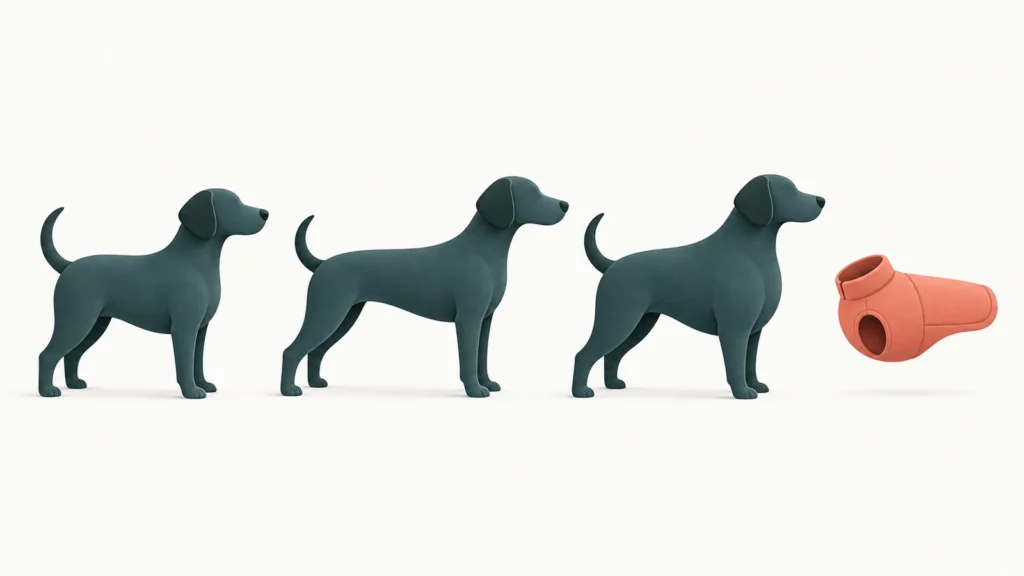
A supplier sends a dog clothing size chart with weight ranges and S, M and L labels. Another sends chest, back and neck numbers. Before comparing the two, a pet apparel brand needs to know what those numbers describe: the dog, the finished garment, or the body range the garment is intended to fit.
That distinction matters whether you are developing a first private-label collection, adapting an existing style or creating a boutique’s own product. A useful chart needs defined measurements, a repeatable method and a clear fit intention behind it.
A size label is the output—not the starting point. This guide sets out what a brand should define before relying on dog apparel sizing. It is a development guide for buyers, rather than instructions for choosing one dog’s retail size.
Do Dog Apparel Brands Need More Than a Weight-Based Size Chart?
Yes: weight alone leaves important development questions unanswered. It does not specify a chest circumference, the length of back to cover or the dimensions of a garment opening. Nor does it describe whether the product should sit close to the body or accommodate another layer.
Public charts show how weight can sit alongside other information. Target’s hosted pet apparel and costumes chart includes pet weight, body-fit fields for neck and chest, and a separate garment-length field. Weight has a role in that example, but it does not replace the other columns.
The development inference is straightforward: a weight bracket cannot resolve variables it does not describe. Keep weight if it helps communicate the intended wearer, but establish the dimensions and fit conditions that support a size assignment. Its usefulness and the priority of other measurements should be considered in the context of the product.
Start With the Difference Between Body Size and Garment Size
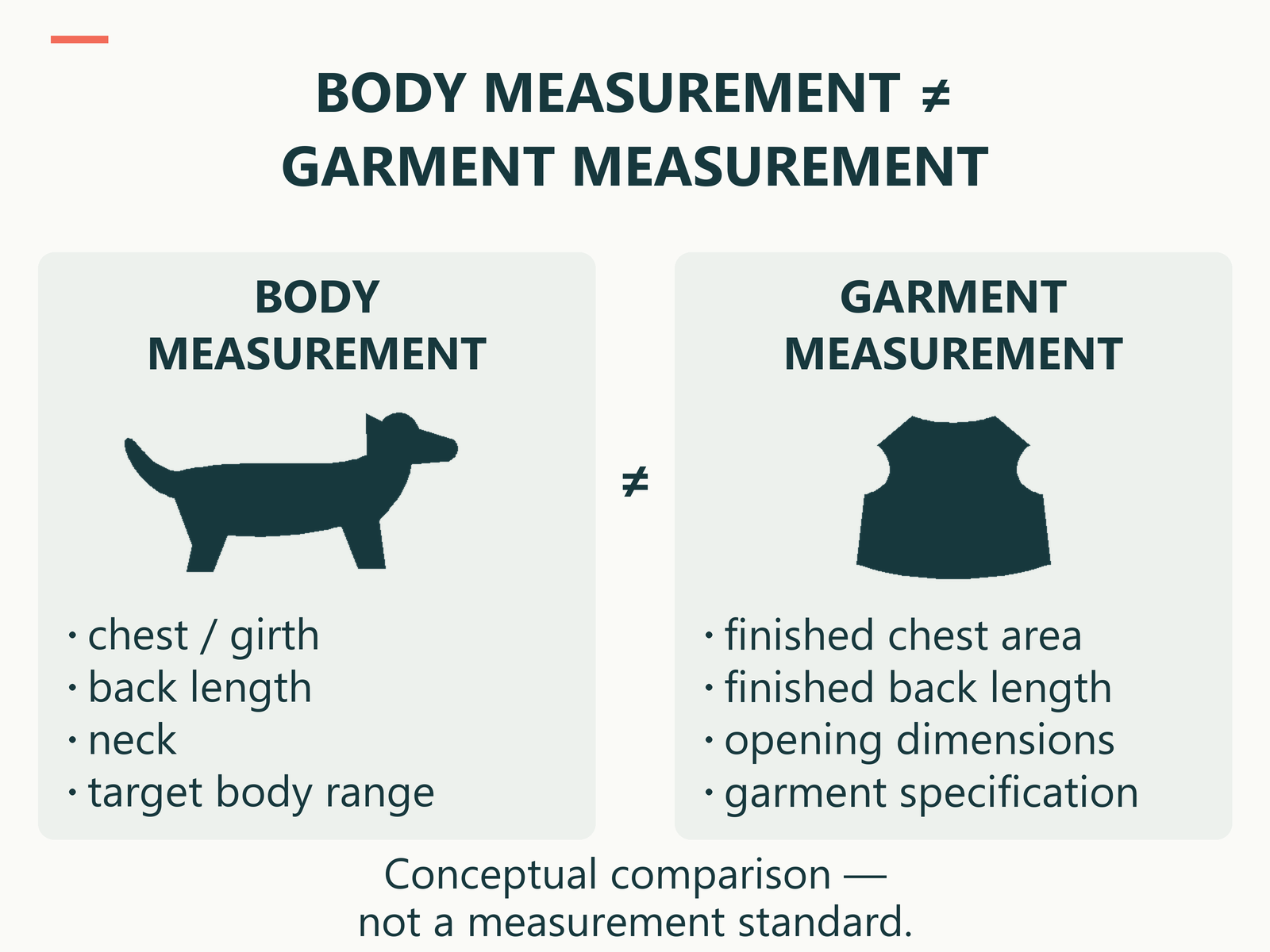
Keep four concepts separate when reviewing a chart or preparing a development brief:
| Concept | What it describes | Buyer clarification |
|---|---|---|
| Body measurement | A measurement taken on the dog. | Which body location and measuring method produced it? |
| Garment measurement | A dimension of the finished garment. | Where, how and in what condition was the garment measured? |
| Fit intent | How this product is intended to relate to the body. | What coverage, closeness, movement and layering are intended? |
| Size assignment | The mapping of supported body ranges into labels. | Which measurements and fit conditions qualify for each label? |
A field called “chest” is incomplete if one person reads it as the dog’s circumference and another reads it as a width across a garment laid flat. Full circumference and flat width are different quantities. Do not double a width automatically: first confirm the garment structure and the agreed method for deriving a circumference.
Also distinguish a target body range from a single finished-garment specification. The range says which bodies the product is intended to accommodate. The specification says how the product itself should measure. A body-range maximum is not automatically the garment’s maximum dimension.
Chest, Back Length and Neck: What Does Each Measurement Tell You?
These are useful starting dimensions, but their definitions belong with the chart. The examples below illustrate published brand instructions, not a universal measuring standard.
| Measurement | Published example | Development question |
|---|---|---|
| Chest / girth | Ruffwear describes the widest rib-cage circuit behind the front legs. | How will that body measure relate to the garment’s chest area, openings and closure? |
| Back length | Hurtta describes the neck/shoulder junction to the tail base. | What back coverage should this style provide, and where will its finished edge sit? |
| Neck | GF Pet uses the natural collar position. | Does the garment neckline sit there, and how does the opening work during dressing? |
Sources: Ruffwear’s apparel guide, Hurtta’s measuring guide and GF Pet’s measuring instructions.
Chest circumference does not describe every part of the chest
Use “girth” for the documented circuit around the body. If a project needs chest depth, width or another proportion, give that dimension its own definition. Do not let “chest” stand for several different measurements in the same brief.
Back length and back coverage answer different questions
The body measurement describes the dog. Coverage describes the product’s intended reach. Document whether a garment-length measurement includes a collar or stops at a neckline seam, and identify its rear endpoint. Those are style decisions to agree, not assumptions to hide in a column heading.
Neck fit also needs an opening description
A neck circumference does not explain whether the garment opens with a fastener or pulls over the head. Include the opening and adjustment arrangement in the fit note. Hurtta’s guide distinguishes upper and lower neck locations, illustrating why an unlabeled neck number needs clarification.
Why Measurement Definitions Matter as Much as the Numbers
Compare wording before comparing values. GF Pet begins back length just below the collar position; Hurtta names the point where neck meets shoulders. The descriptions are not identical. That observation does not establish how far apart two actual measurements would be; it tells a buyer to agree the landmark.
Some instructions also need interpretation. Parisian Pet’s apparel guide describes measuring toward the tail base, then adds an instruction to stop above the tail. Before reusing that definition, clarify the intended endpoint and whether the guidance concerns body measurement or desired garment coverage.
For each measurement, record the object, start and end points, path and conditions. On a dog, agree the stance and how the tape sits against the coat. On a garment, specify whether it is laid flat, whether closures are fastened, and whether elastic is relaxed or measured under a separately defined condition.
A point of measure, often shortened to POM, is easier to interpret when its written description is paired with an annotated drawing. Techpacker’s garment specification tutorial demonstrates labeled measurement arrows, full-versus-half chest values and tolerance fields. These are useful documentation examples; its human-garment measurements are not dog-apparel allowances.
Keep tape slack, garment ease and manufacturing tolerance in separate fields. The first concerns how a reading is taken, the second concerns the intended relationship to the body, and the third concerns an agreed permitted variation in a garment dimension.
Body Proportion: What Weight Alone Does Not Describe
For development, record the relevant body dimensions and describe any proportions the garment needs to accommodate. Ruffwear’s apparel guide discusses broad shoulders and deep chests when describing its vest styles. That is a brand-specific example of shape entering a fit decision; it is not a breed-to-size formula.
If a target wearer description includes “deep chest” or “long back,” translate it into a question the development team can investigate. Does the existing measurement set describe the feature adequately? If another dimension is needed, define it. Do not substitute an automatic breed adjustment.
From Body Measurements to Garment Fit
Fit intent turns a collection of dimensions into a product brief. Instead of writing only “comfortable fit,” describe the intended relationship: a close layer under outerwear, a standalone garment or a shell intended to accommodate another layer. Then describe coverage and the areas that need adjustment.
In human apparel education, Purdue Extension distinguishes wearing ease from design ease. Wearing ease provides room for movement; design ease adds volume for the intended appearance. The manual also explains that fabric affects ease needs. These concepts help frame the development discussion, but their application to a dog garment requires decisions about that particular product.
Do not assign a fixed ease percentage or assume a fabric called “stretch” settles fit. Ask the technical developer to connect the chosen material and construction to the intended body range and finished measurements. FIT’s Technical Design learning outcomes explicitly connect fabric properties, garment measurement and fitting.
A concrete pet-apparel example is Ruffwear’s Furness jacket: its product page describes a relaxed fit, layering over closer-fitting apparel, coverage around the belly, stretch sleeves, a zipper, neck/belly adjustments and a leash portal for wear over a harness. Those details describe more than a size label.
For your own brief, identify:
- Coverage: where the back and belly panels should end, including clearance needed for toileting.
- Leg openings: the intended opening or sleeve position and what must be checked for dressing and movement.
- Closures: their placement, adjustment range and the setting used when measuring the garment.
- Harness or leash access: the intended equipment arrangement and opening location to verify.
- Material and layering: which fabric is proposed and whether another garment or harness sits underneath.
This is a practical briefing list, not a set of validated dimensions. A back opening alone does not establish compatibility with every harness.
Why a Size Label Needs Product Context
A label needs its chart. On the Furness page, Medium maps to its own published body-girth range. That is a specific product reference, not a definition of Medium that another brand should copy.
Even within a brand, check the intended use. Hurtta gives different between-size advice for a shell accommodating a mid-layer and an active overall. The lesson is to document the decision rule for your product, rather than adopt a blanket instruction to size up or down.
A size label does not independently define finished-garment measurements. Read it together with the product’s chart, intended use and garment specification.
A Practical Sizing Framework for Pet Apparel Brands

The following is Meetfunpet’s practical buyer framework, developed from the distinctions above. It is not an externally certified sizing standard.
- Define the body measurement. Identify the target wearer dimensions relevant to the product. Name each dimension and keep it separate from the finished-garment specification.
- Define the measurement method. Agree landmarks, paths, endpoints, units and conditions. Resolve unclear fields before comparing charts.
- Define the fit intent. Describe coverage, closeness, layering, openings, closures and material assumptions. Record unresolved decisions explicitly.
- Validate the style. Check the sample against the agreed specification and intended wearer/use. A chart should remain provisional while important fit questions are unresolved. Detailed wear-test planning belongs in the separate fit-testing workstream.
- Map the result into size assignments. Associate supported body ranges with labels, state how boundaries are handled and identify which chart revision applies.
These steps can involve iteration. An initial range or label may be useful for discussing a sample, but mark it provisional. A sample finding may require changes to the garment, its intended body range or its customer-facing instructions before the assignment is settled.
If a dog’s measurements point to different labels, the system needs an agreed response. That may be further measurement, checking a particular fit constraint or acknowledging that the style does not cover that combination. Do not silently let weight decide.
What to Ask When a Supplier Sends You a Size Chart
Begin with the meaning of the fields. As one published supplier observation, iPeti’s pet-clothing guidance asks buyers to identify whether chart values describe the animal or finished garment. This is that supplier’s guidance, not evidence of a Meetfunpet supplier relationship or an industry-wide practice.
For an initial conversation, clarify six points:
- Which style, material and revision does the chart describe?
- Are values body ranges, finished-garment dimensions or a mixture explicitly labeled by column?
- What units, measurement diagrams and conditions accompany them?
- What fit and layering assumptions are built into the product?
- Which sample and fit-check records support the proposed assignments?
- What remains provisional, including the rule for conflicting measurements or range boundaries?
Ask for missing information in a form that can remain attached to the chart. A verbal explanation of “chest” should become a written definition or marked measurement diagram. These questions establish a common basis for discussion; they are not a complete supplier-chart audit.
Common Sizing Mistakes
- Starting with familiar labels: “our usual Medium” supplies no measurement basis unless the underlying chart is identified.
- Mixing body and garment numbers: similar column names can conceal different objects or methods.
- Adding room twice: do not build a second assumed allowance onto a measurement that already includes deliberate slack without clarifying it.
- Using breed or weight as a shortcut: record relevant dimensions instead of inventing a fixed adjustment.
- Transferring a chart without checking the style: confirm the intended fit and material before treating existing assignments as settled.
- Treating complaints as a correction formula: a size complaint needs its wearer, product and measurement context before it can inform a change.
What Conflicting Size Reviews Can—and Cannot—Tell You
Meetfunpet Market Research Observation: sample PA-029 tracks the zooplus España “Jersey noruego para perros” listing, product 325360. Two traceable reviews from 2021 describe opposite experiences: one says XXL was very small; another says the purchased item was too large. These two historical reports do not provide comparable body weights, body measurements, garment measurements or body-proportion data, or establish matching product versions. They are prompts to investigate the context behind size complaints, not correction formulas. They do not prove a defect, establish how prevalent a sizing issue is, or justify a universal runs-big or runs-small conclusion.
Those are third-party consumer reports examined in market research, not Meetfunpet customer cases or supplier experience.
A Simple Illustrative Example
Illustrative only; not a Meetfunpet client case.
Imagine a startup developing a pullover fleece and a shell jacket. It proposes the same target body range for both and initially calls each sample Medium. The fleece is intended as a close layer; the shell is intended to be worn over it.
The buyer should first keep the common body targets distinct from the two garment specifications. For the fleece, record the opening arrangement and proposed material behavior. For the shell, document layering, closure settings and coverage. Request measurement definitions for both before comparing their finished dimensions.
The shared body target does not tell the developer how much extra room to add to the shell. That remains a style-development question to resolve through the selected construction and sample evaluation. Both products might ultimately retain Medium, or their supported ranges might change. No result is assumed here.
What to Document Before Sample Development
Prepare a compact sizing brief that keeps the target, the proposed garment and unresolved questions visible together:
- Style identifier and intended wearer/use description.
- Body measurement names, proposed ranges, units and illustrated methods.
- Finished-garment points of measure, measurement conditions and agreed tolerances—or fields awaiting technical definition.
- Fit intent covering material, layering, coverage, openings, closures and access.
- Reference or sample identifiers, chart revision and outstanding decisions.
- Provisional size labels and the evidence still needed to confirm their assignments.
A buyer does not need to invent technical values to fill every blank. Identify what is known and ask the developer to resolve the rest. Keep updates tied to a revision so a sample is not reviewed against an obsolete chart.
For how these definitions connect to development materials, see reference sample vs tech pack vs sketch. The sizing brief gives those materials a common measurement basis.
Key Takeaways
- Define the measurement object and method before relying on a number.
- Use weight as context where appropriate; it does not settle dimensional fit.
- Connect body targets to a documented fit intent and garment specification.
- Validate the style before treating size assignments as confirmed. A chart cannot guarantee fit.
Planning a Pet Apparel Development Project?
Meetfunpet supports pet apparel development and manufacturing in China, from product requirements and sampling to private label and production follow-up. If you are preparing a project, bring your product reference, current chart and unresolved sizing questions to a custom pet apparel sourcing discussion.
Research Note
This guide combines apparel education, brand-specific examples, one attributed supplier’s published guidance and a bounded Meetfunpet Market Research Observation. Human apparel concepts are not presented as dog-sizing standards. No first-party direct supplier evidence has been verified for this article. The five-step framework is Meetfunpet’s practical synthesis; the example is hypothetical. Sources and underlying review statements were checked on September 10, 2026.
Sources & Research References
- Purdue Extension, Consumer Clothing, Intermediate Level — ease concepts; printed page 21.
- Fashion Institute of Technology, Technical Design outcomes — technical education.
- Techpacker, garment specification tutorial — commercial technical guidance.
- Hurtta measuring guide and GF Pet measuring guide — brand-specific instructions.
- Ruffwear apparel guide and Furness product page — brand and style examples.
- Target pet apparel chart and Parisian Pet apparel guide — chart fields and measurement wording.
- iPeti pet-clothing guidance — supplier observation.
- zooplus España, product 325360 — original review host for Meetfunpet research sample PA-029.