
Choose the arrangement that covers the work your pet apparel project needs. Buying directly from a factory can make sense when its proposed scope fits your order and you can manage the necessary technical communication and follow-up together. Consider a sourcing partner when you need someone to take on defined development coordination, supplier matching or work across several suppliers.
If you already have a suitable factory relationship, you can also explore keeping it while commissioning specific outside support. In each arrangement, confirm who does the work, what information you will receive and which decisions remain yours.
Here, direct factory sourcing means organizing the order directly with the proposed manufacturing supplier. Partner-supported sourcing means involving another party for agreed sourcing or coordination work. These describe working arrangements; the actual seller, manufacturer and responsibilities still need to be identified for your order.
Compare the work each sourcing route leaves with you
Use this Meetfunpet proposed buyer framework to compare arrangements. It is an editorial guide, not an industry standard or a ranking of supplier types.
| Working arrangement | Conditions to consider | Work the buyer still owns | Boundary to resolve |
|---|---|---|---|
| Direct factory relationship | The proposed production scope fits, and technical work and follow-up have clear owners. | Your agreed communication tasks, requirements and key approvals. | Which work is included, and who performs any work outside the factory? |
| Partner-supported sourcing | You need defined development coordination, supplier matching or work across several suppliers. | Requirements, review, approvals and any work you have not delegated. | Confirm deliverables, charges and access to manufacturing information. |
| Direct relationship with outside support | The direct relationship works, but a specific task needs additional support. | The direct relationship, approvals and coordination between the parties. | Agree how instructions, changes and results pass between them. |
Start with your actual order: the garment, styles, colors, size mix and development work. Check whether the proposed supplier accepts that scope. A small quantity does not automatically require a partner, and a larger order does not automatically favor direct sourcing.
A custom project can also suit direct cooperation if the factory agrees to undertake the necessary development and you can manage that relationship. Conversely, a partner engaged only to find suppliers has not necessarily agreed to develop specifications or manage sample revisions. Identify the missing work before choosing the arrangement.
Make the handoffs explicit before choosing
For each arrangement you are considering, follow how a requirement becomes an instruction, how a change reaches you and how a result reaches the person authorized to approve it. The following pet apparel tasks help make those relationships concrete.
Product requirements and sample revisions
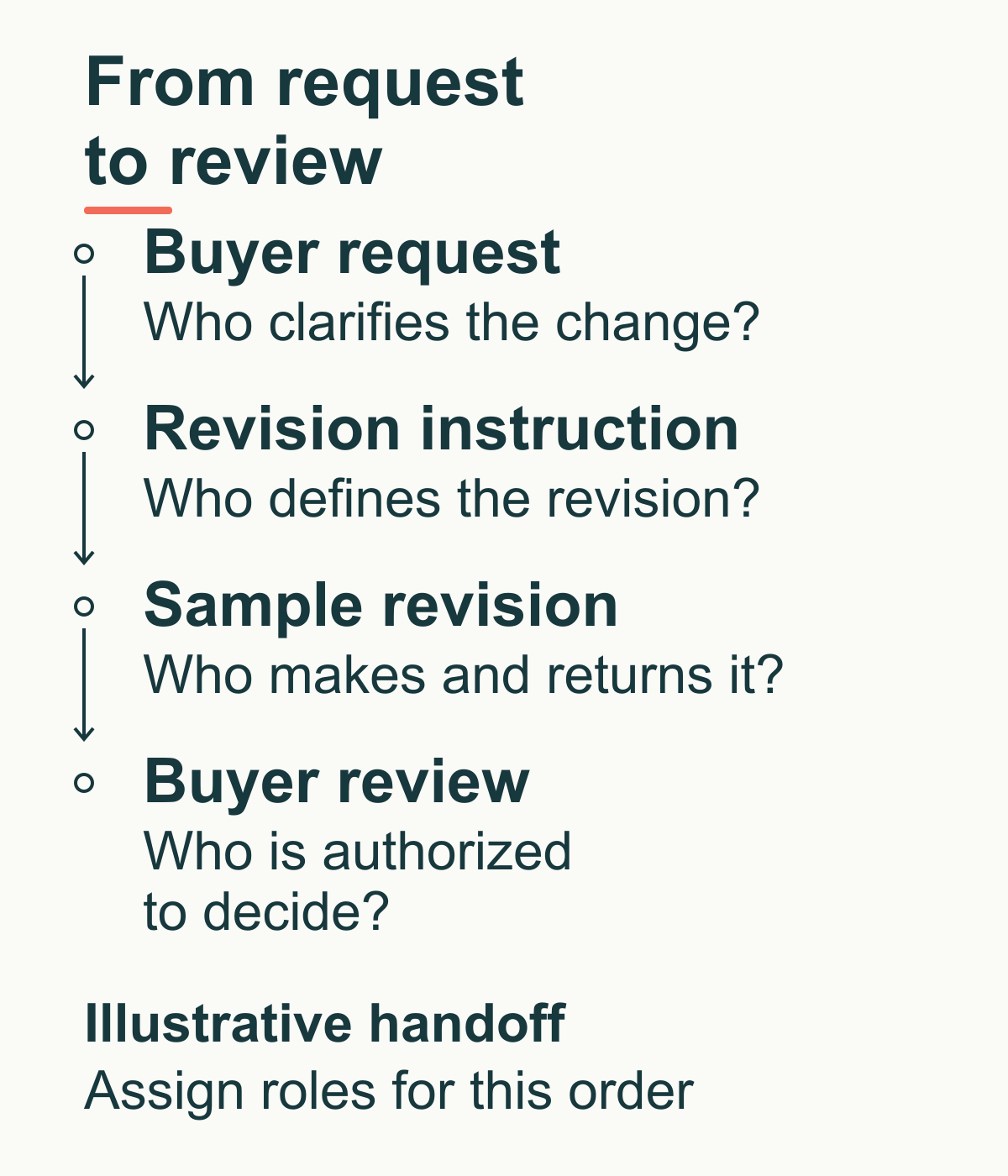
For example, a request to change a dog vest’s belly coverage needs someone to turn the buyer’s intention into a clear instruction for the next sample. Identify who clarifies the request, who revises the relevant specification or pattern, who makes the sample and who returns it for review. This is a planning example, not a completed client project.
In a direct arrangement, agree how your team and the factory’s technical staff will handle that exchange. With a partner, establish which parts it coordinates and who performs the technical work. A forwarded photograph may communicate your concern while leaving the actual revision undecided.
Keep the work specific to the product. CottonWorks’ sweater-manufacturing course description distinguishes knitting systems, garment assembly and linking. Those are examples of technical work to identify when discussing a sweater project; they do not establish any particular supplier’s capability. Ask who handles the construction you need, without assuming that every garment in a collection requires the same process or a different factory.
Production coordination and changes
Agree who obtains production updates and who brings a proposed material, process or production-location change to your attention. If the garment maker and a label supplier are separate parties, identify who coordinates the label delivery and communicates changes affecting that handoff.
With direct sourcing, your team needs an agreed route for obtaining and acting on that information. With partner support, specify what the partner will obtain, what it will pass on and what remains your responsibility. One contact can organize an exchange, but a task outside that contact’s agreed scope still needs an owner.
Adding a coordinator introduces another handoff to manage. Ask how technical questions will reach the person able to answer them, and whether replies will retain the relevant conditions. If you retain a factory relationship and hire separate support, make sure both parties understand where their work meets.
Quality evidence and buyer approvals
When an offer includes “quality follow-up,” clarify what you will receive: progress information, coordination of a check, or the findings from a defined inspection. Ask who performs the work and what it covers. Do not assume the coordinator is also an independent inspector.
Intertek’s textile and apparel inspection description separates checks of products and workmanship from audits of factory procedures and systems. That distinction helps frame your request: evidence about a facility and evidence about the garments answer different questions. Neither a supplier’s “factory” description nor an offer of QC support establishes that your product has passed the relevant checks.
Name the person authorized to approve samples, material changes and the relevant order decisions. Delegating communication does not itself transfer that authority. The arrangement should make clear who gathers the information, who reviews it and who may authorize the next action.
Check who will make the garments—and who you are buying from
Ask the proposed supplier or partner to distinguish the party accepting your order, the intended manufacturing location or locations, and the people coordinating the work. Some roles may be combined. Where they are separate, understand how they connect for this order.
New Zealand Government Procurement’s due-diligence guidance calls for independent verification of supplier identity and delivery capability using more than one source. Applied to this decision, a business description is a starting point for clarification; it does not settle the production relationship.
The OECD’s garment and footwear due-diligence guidance discusses subcontracting, transparency and assessing intermediaries. Within its responsible-business-conduct scope, using an intermediary does not remove the sourcing enterprise’s due-diligence responsibility. This is not a pet-product quality standard. The practical implication here is to keep the actual production arrangement visible whichever route you choose.
“Direct factory access” should therefore be explained in concrete terms: who can communicate with the production team, through which arrangement, and about which work? Access does not establish factory ownership or show that the buyer contracts directly with the manufacturer. Likewise, owning a factory does not by itself establish that every part of your order will be made there. Clarify the arrangement without treating subcontracting as automatic evidence of misconduct.
Compare the same scope before deciding which route costs less
Identify the product and work covered by each price. Does the offer include the development, sample coordination or checks you intend to commission? Ask how that work is charged and what is excluded. Do not assume every partner uses a separate service fee or the same resale arrangement.
New Zealand Government Procurement’s evaluation guidance considers technical suitability, delivery capability and overall cost rather than purchase price alone. For your comparison, also identify the work your own team would retain. Leave its cost unknown if you do not have a defensible basis for estimating it.
There is no price winner established by the words “factory” or “partner.” Once you have actual offers, compare pet apparel supplier quotes on the same basis. Different or incomplete scopes need clarification before they support a cost conclusion.
Choose a route, then evaluate the people who will deliver it
Write a short decision for this project: the arrangement you want to explore, the work you will retain, the work you need someone else to undertake, and any responsibility or information still unresolved. More than one arrangement can remain worth comparing. Clarify an essential gap before relying on the proposed division of work.
Then evaluate the specific pet apparel supplier or partner against the project. Choosing a working model does not establish that a particular business can deliver it. Revisit the arrangement if the product, order scope or support you need changes.
If you need help with a defined part of the project, you can discuss the sourcing support your project needs with Meetfunpet. For sourcing-service projects, Meetfunpet coordinates agreed work with production partners; those partners carry out manufacturing, while you retain key product and commercial approvals.