
When several pet apparel suppliers offer similar-looking products, the unit price is an easy place to start. It is also an incomplete basis for choosing who should handle your order. A quotation needs to be read alongside the product, order structure, development work and delivery arrangements it actually covers.
To evaluate a pet apparel supplier beyond price, ask whether its proposed product, quantities, development scope, commercial terms, execution process and communication fit your project. Keep the supporting evidence beside each answer.
The lowest unit price is not automatically the lowest sourcing risk. Equally, a lower price is not evidence of lower quality. The aim is to understand the offer well enough to make a project-specific decision.
Why Unit Price Alone Is Not a Supplier Evaluation
New Zealand Government Procurement guidance separates technical merit, supplier capability and capacity, and value for money. Its total-cost principle does not equate value with the lowest purchase price. These are general procurement concepts, applied here to a small pet apparel buying decision.
Price still matters. The same authority’s evaluation-methodology guidance includes a lowest-price approach that first identifies offers meeting the requirements. A lower-priced eligible offer can therefore be a sensible choice. The missing step is establishing eligibility and scope before treating price as decisive.
For your shortlist, separate a requirement the supplier cannot meet from a detail that remains unanswered. Neither an attractive price nor a polished presentation resolves an unanswered question about the product you will receive.
Start With Supplier Fit, Not Supplier Rank
Write a short decision statement: what must this supplier support for this order to work? For example, an unchanged stock assortment and a new coat pattern are different assignments. Decide which requirements are essential and which you can adjust before evaluating the responses.
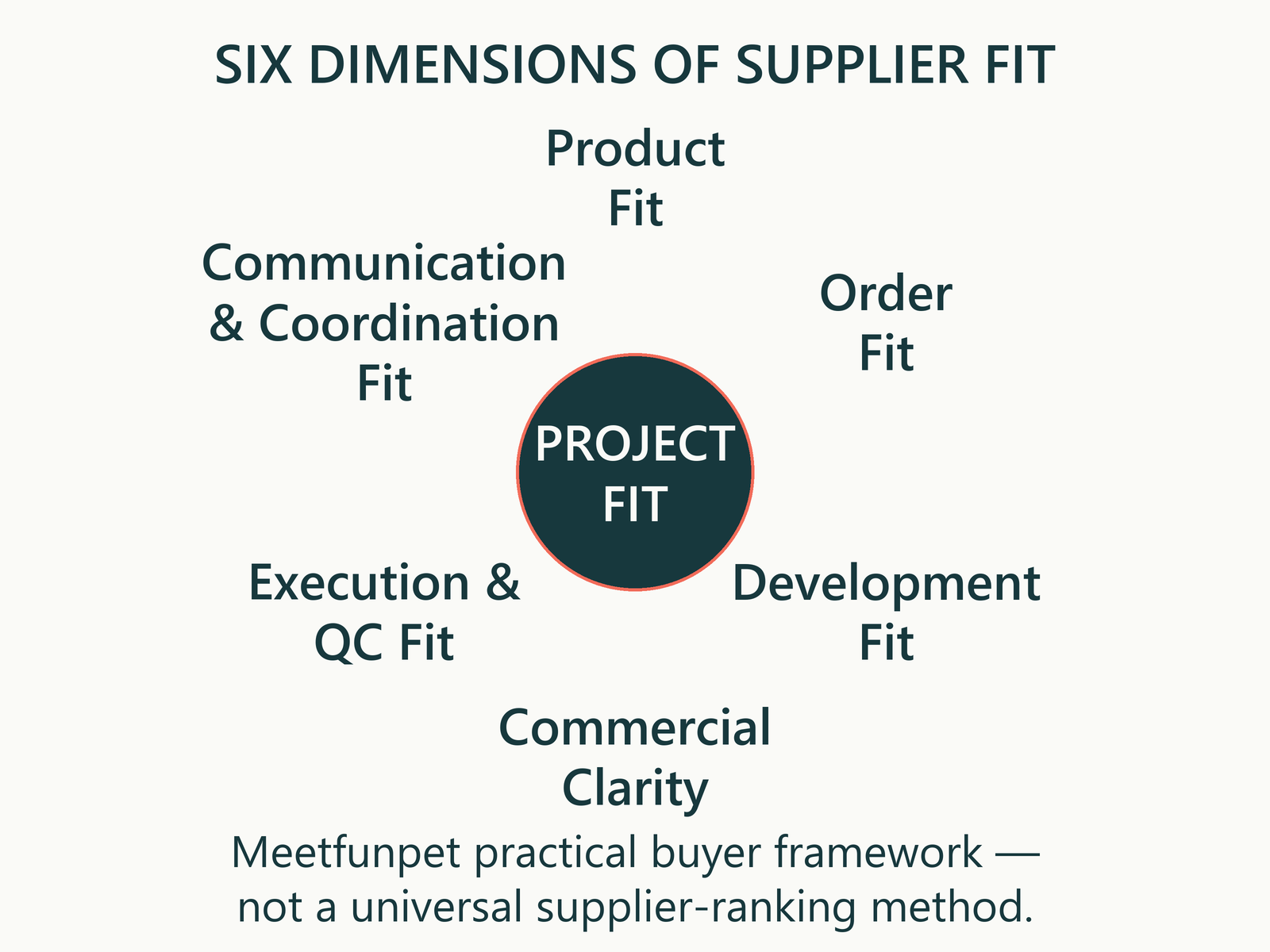
Then use the six dimensions below as a practical Meetfunpet framework. They organize a buyer’s judgment; they are not an industry standard, a certified scorecard or a universal supplier-ranking method.
If your starting request still leaves the project unclear, use the pet apparel RFQ checklist first. This guide addresses how to interpret the supplier’s response.
1. Product Fit: Can the Supplier Handle This Product?
Look for relevance to the construction you need. The Fashion Institute of Technology’s technical-design learning outcomes connect fabric properties with pattern development, sewing, finishing and fit. CottonWorks’ sweater-manufacturing education covers knitting systems, garment assembly and linking. These technical distinctions support asking about the actual garment process behind a catalogue category.
For a proposed dog sweater, ask for a relevant example and an explanation of its construction. For a fleece layer, focus the discussion on the chosen fabric and seams. For a raincoat project, ask how the proposed construction relates to the performance you intend to claim. Do not treat a photograph as test evidence.
A useful response identifies a comparable style, explains meaningful differences and states what still needs development or testing. “We make pet clothing” leaves those points open.
Sizing language also deserves clarification. In one Meetfunpet supplier inquiry recorded on September 8, 2026, the contact described an example chart as garment measurements and said applicability depended on the style. The chart itself was not available for document review. The usable observation is the need to clarify measurement meaning, not proof that the supplier’s sizing system works.
2. Order Fit: Does the Supplier Match Your Order Structure?
Ask whether the supplier accepts the assortment you intend to buy, including styles, colors, sizes and branding route. “MOQ accepted” is incomplete if the answer refers to a different configuration. For the mechanics behind these conditions, see what affects MOQ for pet apparel orders.
A dated Meetfunpet inquiry illustrates the distinction. One supplier contact stated that an unchanged stock style could be purchased in two pieces with mixed sizes; customer-logo replacement started at 200 pieces in one style and one color with mixed sizes; the discussed pattern-modification/custom route started at 300 pieces under the same style, color and mixed-size conditions.
Those were separate supplier claims recorded on September 8, 2026, not market benchmarks or current guaranteed terms. The two-piece stock answer did not establish permission to mix colors. Specific SKU availability and formal conditions remained open.
For your decision, record whether the proposed combination meets your assortment needs. A low entry quantity is useful only if the product and permitted mix suit the project. If the supplier requires a different mix, decide whether that is an acceptable adjustment or a reason to set this option aside.
3. Development Fit: What Can the Supplier Actually Develop?
Evaluate the scope behind an offer to customize. Use these distinctions to interpret the response, rather than treating “OEM” or “private label” as a complete answer:
- Existing style: Is the offer for the supplier’s current product without changes?
- Logo or private label: Which logo, label or tag operation is included, on which styles?
- Material or color modification: What alternative is proposed, and what remains subject to sourcing or approval?
- Pattern modification: Who will revise the pattern and check the requested size changes?
- Full custom development: Which pattern, specification, sample and revision tasks will the supplier undertake?
Sample purpose matters too. Techpacker’s garment-sampling guide distinguishes early development, fit and pre-production samples. Its descriptions show why “sample available” does not identify the sample’s purpose or whether final materials are being used. Terminology and the agreed scope should be confirmed for your project.
A separate Meetfunpet supplier inquiry record dated September 8, 2026, notes one size or production-process modification included with a modified sample, provided the fabric was unchanged. This is a recorded supplier claim, not a tested service outcome. It shows why a revision allowance needs its conditions attached.
Before selecting for development, clarify the deliverables, revision allowance, charges and approval point. Ask who will retain the approved specifications and how later changes will be recorded. A supplier may fit a limited modification project even when full development remains outside the agreed scope.
4. Commercial Clarity: What Is Included in the Quote?
For supplier selection, establish whether the price describes the proposed work clearly enough to assess. Check the quoted style or specification, quantity and assortment, branding and packaging scope, sample or development charges, currency, payment schedule, validity and delivery basis. Ask the supplier to identify exclusions.
Two prices for different materials, different modification work or different delivery responsibilities are not yet like-for-like offers. That is a comparability issue; it does not establish which supplier is better.
The International Chamber of Commerce explains that Incoterms rules allocate delivery obligations, risks and costs. They do not settle product specifications or payment timing, method and currency. A trade term therefore cannot fill every gap in a quotation.
The decision here is whether the supplier has made its commercial offer understandable, including what is provisional. Detailed price normalization belongs in a separate quotation comparison. Do not reject an otherwise relevant option simply because its first indicative quote needs clarification.
5. Execution and Quality-Control Fit: How Will the Order Be Managed?
Separate technical ability from availability for your order. The procurement guidance cited above includes current commitments and availability to deliver. A supplier’s general capacity statement does not establish a production slot for your project.
Ask what starts the quoted lead time, which approvals are needed first, who coordinates production and how a change to the schedule would be communicated. Record an estimated timeline as estimated until the relevant order conditions are agreed.
Look for a defined checking process
Intertek’s textile and apparel inspection description identifies checks at different production stages, workmanship assessment, inspection findings and corrective action. For your supplier discussion, translate that principle into a small set of evidence requests:
- A style-specific specification and approval reference that identifies the version to be followed.
- A proposed check sheet covering relevant measurements, agreed tolerances, construction, closures and packing requirements.
- A named checking responsibility and an explanation of when checks occur.
- A blank check-sheet template or an anonymized example that does not expose another customer’s confidential information.
These are proposed evidence requests, not mandatory documents in a universal pet apparel system. Ask for a proportionate explanation of the process; a small stock purchase and a developed production order need different depth.
Separate the process from proof of execution
A proposed check sheet demonstrates what someone intends to check. A relevant completed record provides evidence that a check occurred within its stated scope. Neither establishes every future outcome.
Intertek distinguishes assessment of factory quality systems from sampling finished goods. The practical implication is that an approved development sample cannot, by itself, establish consistency across a later bulk order. Ask how the approved reference connects to production checks and how deviations will be handled.
Keep the status precise: process described, document reviewed, sample assessed, or production evidence available. Do not collapse those different stages into “quality verified.”
6. Communication and Coordination Fit: Are Important Questions Actually Resolved?
Assess what the exchange resolves. A useful response connects an answer to the relevant style and order scenario, separates confirmed information from estimates, and states who will resolve anything outstanding. This is a practical communication test, not a predictor of production reliability.
For example, when you ask whether sizes can be mixed, an answer tied to one style and one color is more usable than an unrestricted “yes.” If your proposed order contains two colors, the remaining question is visible.
Identify the responder as well. In Meetfunpet’s September 8, 2026 inquiry record, a platform’s automated answer was excluded from formal supplier evidence; a human contact’s scoped clarification was retained. The automated answer was not treated as a supplier contradiction.
Use the same discipline with your own exchanges. Keep the date, channel, answer and applicable conditions together. A quick acknowledgment may leave the decision unresolved. A slower answer with a clear technical explanation may be useful. Neither response speed alone nor conversational fluency establishes whether an order will be executed reliably.
A Practical Supplier Fit Framework for Pet Apparel Buyers
Use this framework to organize the shortlist. For each dimension, write your requirement, the evidence received, the remaining question and its owner. Keep the fit decision separate from the evidence status.

| Dimension | Decision to make | Evidence to seek |
|---|---|---|
| Product fit | Does the proposed product match the required construction and function? | Relevant style, specification and scoped sample or test evidence. |
| Order fit | Does the accepted order match the required assortment? | Written style, color, size and customization conditions. |
| Development fit | Is the necessary development work included? | Deliverables, revision boundaries and approval responsibilities. |
| Commercial clarity | Is the offer understandable? | Quote scope, exclusions and provisional terms. |
| Execution and QC fit | Is there a credible plan for this order? | Schedule basis, checking process and relevant execution records. |
| Communication and coordination fit | Are important decisions being resolved? | Dated answers, conditions and assigned follow-up actions. |
For fit, use “matches the stated requirement,” “requires clarification,” or “does not match this project.” Alongside that, identify whether the support is a supplier statement, a reviewed document or an observed result. A clear claim can justify further evaluation without becoming verified capability.
Avoid averaging away an essential failure. If the required development work is unavailable, favorable answers elsewhere do not supply it. You can change the project brief or choose another option, but record that decision explicitly.
What Supplier Listings Cannot Tell You
CIPS describes desk appraisal, field research and third-party appraisal as different ways of evaluating suppliers. A website is part of the information-gathering stage. Its contents do not, on their own, establish who will make your selected style or how your future order will perform.
One Meetfunpet supplier inquiry record includes a contact’s explanation of the store operator and a claim of own-factory production. The record explicitly leaves documentary identity verification pending. That distinction matters: obtaining an answer and verifying the underlying relationship are different steps.
Clarify the seller, the proposed production arrangement and who accepts responsibility for the agreed scope. Do not infer suitability from a “factory” label or a platform badge alone. If a listing links to an assessment, examine what it actually covers. This guide does not prescribe a company audit or provide legal due diligence.
Red Flags vs Questions That Simply Need Clarification
Do not label every unknown a red flag. In this framework, an unknown calls for a targeted question; a material concern calls for a pause until it is addressed.
Questions that need clarification
An unspecified packing charge, an approximate sample date or an unclear size-mix condition may be resolvable. Ask a bounded question and agree when the answer is needed. A supplier declining work outside its capability is also useful information, not evidence of misconduct.
Reasons to pause the decision
Pause if a material contradiction remains after clarification, if the supplier substitutes a different product scope without identifying the change, or if responsibility for the proposed order remains unresolved. These are decision concerns in the stated project, not automatic proof of fraud or poor manufacturing.
Apply the same care to apparent inconsistencies: check whether two answers came from different actors or referred to different order scenarios before treating them as a contradiction. Record what would resolve the concern.
A Simple Illustrative Comparison
Illustrative only — not a Meetfunpet client case. Suppose a small brand is comparing options for an unchanged stock assortment, while considering a later pattern modification. All conditions below are invented to demonstrate the decision logic.
| Question | Option A | Option B |
|---|---|---|
| Initial unit price | Lower. | Higher. |
| Current stock assortment | Requested mix accepted in writing. | Requested mix accepted in writing. |
| Later pattern change | Outside the offered scope. | Development scope proposed; sample assessment pending. |
| Evidence still needed | Selected product assessment and order arrangements. | Selected product assessment, development review and order arrangements. |
For the unchanged stock project, Option A could remain a sensible candidate. For the pattern-change project, Option B warrants further development evaluation. Its higher price does not prove better quality, and its development proposal does not prove successful execution. The preferred next step changes with the assignment and the evidence.
What to Record Before Choosing a Supplier
Keep a short decision record that someone else can read without reconstructing the whole conversation:
- The project scope and essential requirements used for the decision.
- The supplier and contact identifiers, with unresolved entity questions stated.
- The dated response, quotation or document supporting each material conclusion.
- The conditions attached to order quantities, development and delivery.
- The evidence still needed, its owner and the decision it prevents.
- The reason to proceed, seek clarification or stop evaluating this option.
State the next commitment precisely: requesting a sample, reviewing documents and placing a production order are different decisions. Revisit the assessment when the scope or supporting evidence changes.
Key Takeaways
- Evaluate price alongside the product and work it actually covers.
- Attach MOQ and customization answers to their stated conditions.
- Separate supplier claims, documents, samples and production evidence.
- Use unresolved questions to guide follow-up, without treating every unknown as a red flag.
- Choose the next step for a specific project; avoid a universal supplier ranking.
Looking for a Better-Fit Pet Apparel Supplier?
Meetfunpet is a China-based pet product sourcing partner. If you need help clarifying supplier options and coordinating the next steps, explore our sourcing services. Start with the product, proposed order and questions you need resolved so the discussion can focus on supplier fit.
Research Note
This guide combines public procurement guidance, apparel technical sources and anonymized supplier statements traced to dated Meetfunpet supplier inquiry records from September 8, 2026. The internal examples are supplier inquiry observations, not customer cases, audits, verified capabilities or production results. Full original chat screenshots were not available among the source materials reviewed for this guide. The six-dimension framework is Meetfunpet’s practical synthesis. Research checked September 10, 2026.
Sources & Research References
- New Zealand Government Procurement: evaluation criteria.
- New Zealand Government Procurement: evaluation methodology.
- CIPS: supplier evaluation.
- Fashion Institute of Technology: technical-design learning outcomes.
- CottonWorks: sweater manufacturing.
- Techpacker: garment sample types.
- ICC: Incoterms and commercial contracts.
- Intertek: textile and apparel inspection.
- Intertek: textile and apparel auditing.