
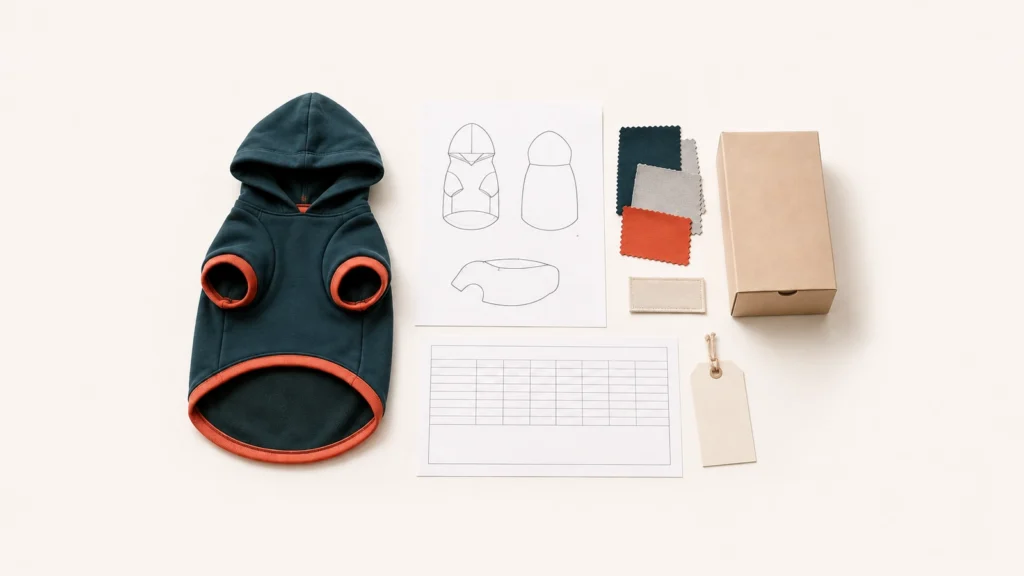
Imagine asking three suppliers to quote 500 dog hoodies.
One supplier assumes an existing hoodie made from stock fleece and packed in a standard polybag. Another assumes custom fabric, a woven label, and branded packaging. A third quotes the garment only and leaves branding out.
All three suppliers may be responding to the same request for “500 dog hoodies,” but they are not quoting the same project.
A useful pet apparel RFQ should clearly state the product or reference, approximate quantity, size scope, customization and branding direction, packaging requirements, and quotation basis. Details that are not yet finalized can remain open, but they should be identified instead of left for suppliers to assume.
That is why a useful pet apparel RFQ is not simply a request for a price.
It should give suppliers enough information to understand the scope they are quoting, while making it clear which decisions are already confirmed and which are still open.
For a small pet brand, boutique, retailer, or e-commerce seller, this does not mean every specification must be finalized before contacting suppliers.
A better principle is:
Clarity matters more than completeness.
And when something is still undecided:
Unknown is acceptable. Unstated assumptions are the problem.
What Makes a Pet Apparel RFQ Useful?
An RFQ—request for quotation—should help a supplier understand three things:
- What product are you asking them to quote?
- What order, customization, and packaging scope should they assume?
- Which details are confirmed, and which still need discussion?
The more important details remain open, the more carefully the first quotation should be treated.
For example, if the fabric, logo method, packaging, and size breakdown are all still undecided, the first price may be useful as an indicative quotation, but it should not automatically be treated as the final production price.
The sourcing route also matters.
An existing supplier style may require relatively little information to start. A modified style needs more detail. A full custom product usually requires increasingly specific measurements, materials, construction details, and technical information before the quotation becomes reliable.
A complete tech pack can be valuable, but it is not a universal requirement for every first pet apparel RFQ.
A Practical Three-Level RFQ Framework
There is no universal pet apparel industry rule that divides RFQ information into “must,” “should,” and “optional” fields.
For a practical first RFQ, however, it helps to separate information into three levels:

1. Clear Enough to Start
The supplier should understand the basic project scope.
Typically this includes:
- Product or reference
- Approximate quantity
- Basic size scope
- Sourcing or customization direction
- Branding requirement
- Packaging direction
2. Add When Known
These details make the quotation more useful and reduce assumptions:
- Material or fabric direction
- Colors
- Size and color breakdown
- Measurements
- Functional requirements
- Logo method and placement
- Target market
- Shipping destination
- Target timeline
- Sample requirement
- Testing or documentation requirements, when applicable
- Requested quotation basis or trade term
- Preferred quotation currency
3. Keep Open When Necessary
Some decisions may still be unresolved when the first RFQ is sent.
That can include:
- Exact fabric specification
- Final size mix
- Final logo application method
- Final packaging structure
- Certain construction details
The key is to mark them as open rather than leaving suppliers to guess.
For example:
“Fabric not finalized. Looking for a soft medium-weight fleece suitable for a fall/winter dog hoodie.”
or:
“Sizes XS–XL planned. Final quantity by size is not yet confirmed.”
That gives the supplier both useful direction and a clear boundary.
Pet Apparel RFQ Checklist at a Glance
| Information | Practical Priority | Why It Matters |
|---|---|---|
| Product / reference | Clear enough to start | Defines what is actually being quoted |
| Approx. quantity | Clear enough to start | Can affect MOQ and production setup |
| Size scope | Clear enough to start | Changes SKU and order complexity |
| Customization direction | Clear enough to start | Existing, modified, and custom projects involve different work |
| Branding scope | State clearly | Logos, labels, and trims can affect quotation scope |
| Packaging scope | State clearly | Standard and custom packaging involve different assumptions |
| Material | Add when known | Can affect construction, feasibility, and cost |
| Colors | Add when known | May affect material purchasing and order structure |
| Size/color breakdown | Add when known | Helps suppliers understand SKU complexity |
| Functional requirements | Add when relevant | Prevents suppliers from quoting the wrong product specification |
| Target market | Add when known | Can identify labeling, packaging, testing, or documentation questions |
| Destination | Depends on quote scope | Important for freight or landed-cost quotations |
| Timeline | Add when known | Helps assess whether the project is realistic |
| Sample requirement | Add when relevant | Clarifies whether sample work is part of the current discussion |
| Quote basis / trade term | Clarify | Prevents EXW, FOB, or freight-inclusive prices from being compared as equivalents |
| Quote currency | Clarify | Makes supplier quotations easier to compare |
| Target price | Optional | Can guide development but may also anchor pricing |
| Complete tech pack | Route-dependent | Becomes more important as customization increases |
Start With a Clear Product Reference
Before discussing price, the supplier needs to understand what product you are referring to.
For an existing supplier style, this might be:
- Supplier SKU
- Catalog link
- Product screenshot
- Style number
For reference-based sourcing, it might be:
- Product photo
- Sketch
- Similar product
- Physical sample
For a more customized development, additional information may later include:
- Measurements
- Construction details
- Fabric requirements
- Artwork
- Technical specifications
The important distinction is not whether the buyer has a “professional-looking document.”
It is whether the supplier can understand the product being quoted.
A product image with clear notes may be more useful than a vague document containing very little product information.
As customization increases, however, relying only on a photo becomes less sufficient.
Describe the Order Shape: Quantity, Colors and Sizes
A pet apparel order is not defined by total quantity alone.
Consider:
500 pieces of one hoodie, one color, and a narrow size range
versus:
500 pieces divided across two styles, four colors, and six sizes.
Both have the same total quantity, but the order structure is very different.
For an initial RFQ, try to provide:
- Approximate total quantity
- Number of styles
- Number of colors
- Planned size range
- Approximate size or color breakdown, if available
For example:
Approx. 500 pcs total, one dog hoodie style, two colors, sizes XS–XL. Final size breakdown is still being planned.
That gives a supplier far more useful context than:
“Please quote 500 dog hoodies.”
Size information matters particularly in pet apparel because the order may be spread across several size variants, and custom sizing may require additional development.
You do not need a finalized grading system for every first inquiry, but the supplier should know whether you expect to use an existing size chart or develop a new sizing system.
For more detail on why quantity structure can change supplier requirements, see what affects MOQ for pet apparel orders.
State the Sourcing and Customization Route
The word “custom” can describe very different projects.
An RFQ should make the intended level of customization clear.
Existing Supplier Style
The buyer may accept:
- Existing design
- Existing pattern
- Standard material
- Available colors
The main changes may be limited to quantity, size selection, or branding.
Existing Style With Branding or Selected Modifications
The buyer may request:
- Logo
- Main label
- Care label
- Hangtag
- Color change
- Small construction adjustment
This creates a different quotation scope from simply buying the supplier’s standard product.
Full Custom Development
The project may involve:
- New pattern
- Custom measurements
- Custom construction
- Different materials
- New functional details
- Multiple sample revisions
A supplier quoting an existing style and a supplier developing a new style are not pricing equivalent work.
If you are still deciding which route makes sense, say that clearly.
For example:
“Existing or similar supplier style preferred. Open to selected modifications if needed.”
That is more useful than simply writing:
“Custom dog hoodie required.”
You can also explore pet apparel sourcing options as you clarify the route for your project.
Describe Materials and Functional Requirements Without Over-Specifying
A buyer does not need to know the exact fabric code before every initial RFQ.
But descriptions such as:
“Good material”
do not provide much useful direction.
A more helpful starting point could be:
“Soft fleece suitable for a fall/winter dog hoodie.”
Or, if more is known:
“Medium-weight brushed fleece with some stretch, intended for a comfortable fall/winter dog layer.”
The same principle applies to functional requirements.
If the product is intended to include:
- Water resistance
- Warmth
- Stretch
- Reflective details
- Leash access
- Lightweight construction
- A particular closure system
state that intended function.
However, an intended product claim is not the same as verified performance.
If a performance claim matters commercially or for compliance, the final specification—and any testing or documentation needed to support that claim—should be confirmed before production.
Include Branding and Packaging in the Quote Scope
Branding should be discussed before comparing garment prices.
If branding is required, say what you currently expect.
This may include:
- Logo application
- Main label
- Size label
- Care label
- Hangtag
- Branded packaging
You do not necessarily need to know the final application method.
For example:
“Logo required. Final application method is still open.”
That allows a supplier to identify the open decision rather than assuming either “no logo” or a specific decoration method.
Packaging works the same way.
For example:
“Standard individual packaging is acceptable for the initial quotation.”
or:
“Branded retail packaging is required, but final packaging structure is not yet confirmed.”
This matters because standard supplier packaging and fully customized retail packaging may involve different materials, setup requirements, MOQs, and costs.
For private label pet apparel, include your current branding and packaging direction in the RFQ.
Clarify the Market, Destination and Quote Basis
These three pieces of information are related, but they are not interchangeable.
Target Market
The target market tells the supplier where the product is intended to be sold.
For example:
“Target market: United States.”
This context can help identify questions around:
- Labeling
- Packaging
- Documentation
- Testing
- Retail presentation
But simply naming a target market does not replace a product-specific compliance review.
Requirements depend on the product, claims, materials, market, and other factors.
Shipping Destination
The target market and physical shipping destination may be different.
Destination becomes particularly important if you want the supplier or sourcing partner to quote:
- Freight
- Landed cost
- Destination-inclusive delivery
- Other logistics costs
If you only need an initial product price at the factory side, the destination may have less influence on the garment price itself.
Even then, it can still provide useful commercial context.
Quotation Basis or Trade Term
Two quotations cannot be compared properly if one is based on EXW pricing and another includes additional freight or export-related costs.
If you already know the trade term you want, state it.
If you do not, ask the supplier to identify the basis of the quotation clearly.
For example:
“Please state whether the quotation is EXW, FOB, or based on another delivery term.”
A small buyer does not need to become an Incoterms expert before sending an RFQ.
But the basis of each quotation needs to be visible before prices are compared.
The same applies to currency.
If you want all suppliers to quote in USD, say so.
Include a Realistic Timeline and Sample Requirement
A supplier does not always need an exact production date in the first RFQ.
But a target launch or required delivery window can identify obvious timing problems early.
Examples:
“Target launch: Spring 2027.”
or:
“Required delivery before November.”
The sample requirement can also be stated at a basic level.
For example:
“Please quote the existing sample first.”
or:
“Customized sample required before bulk production.”
or:
“Initial pricing only; sample requirements will be discussed after supplier evaluation.”
This keeps the sampling scope clear without turning the RFQ into a full product-development plan.
Should You Include a Target Price?
Not necessarily.
A target cost can be useful when your business already has a clear commercial constraint.
It may help a supplier determine whether the project is realistic or suggest:
- A different material
- Simpler construction
- A different customization level
- Another sourcing route
But there is a trade-off.
Sharing a target price can anchor the quotation around that figure.
One practical way to decide is:
Share a target cost when you want suppliers to work toward a known commercial limit. Leave it open initially when you first want to understand independent supplier pricing for the defined scope.
Either approach can be reasonable depending on what you are trying to learn from the RFQ.
Do You Need a Tech Pack Before Requesting a Pet Apparel Quote?
Not for every sourcing route.
The amount of technical information normally increases as customization increases.
| Project Type | What May Be Enough to Start | What Usually Needs More Detail |
|---|---|---|
| Existing supplier style | SKU/reference, quantity, sizes, branding direction | Packaging or selected changes |
| Modified existing style | Reference, modification notes, quantity, sizing | Material, measurements, construction changes |
| Full custom development | Sketch/reference and product requirements | Technical specifications, measurements, materials and construction |
For a small brand, this distinction matters.
You do not need to delay every sourcing conversation until you have prepared a complete technical package.
But you also should not expect a rough product photo and a highly detailed specification to produce the same level of quotation accuracy.
As the product becomes more customized, the need for detailed specifications increases.
For custom pet apparel development, use the first discussion to identify which specifications still need to be developed.
Give Every Supplier the Same Baseline—and Ask Them to State Assumptions
Sending the same RFQ information to each supplier is one of the simplest ways to improve quotation comparison.
Try to keep the baseline consistent:
- Product reference
- Approximate quantity
- Sizes
- Colors
- Customization
- Branding
- Packaging
- Sample requirement
- Quote currency
- Quotation basis
- Relevant delivery assumptions
There is another useful step:
Ask suppliers to state important assumptions and exclusions.
For example:
- Which fabric was assumed?
- Is branding included?
- Is custom packaging included?
- Which trade term is quoted?
- Is sampling included or separate?
- Which details still require confirmation?
This is especially important when parts of the project remain open.
Suppose the buyer writes:
“Fabric not finalized.”
Supplier A may calculate the price using one fleece specification while Supplier B assumes another.
If those assumptions are visible, the buyer can understand why the numbers differ.
If they remain hidden, two prices may look directly comparable when they are not.
If a supplier proposes an alternative material or construction, keep that option separate from the baseline quote.
If you need help clarifying requirements and coordinating supplier quotations, explore Meetfunpet’s pet product sourcing support.
Common Pet Apparel RFQ Mistakes
Asking Only “How Much?”
A price without enough product and order context may be based largely on assumptions.
Giving Only the Total Quantity
Total quantity alone does not reveal the number of styles, colors, or sizes involved.
Forgetting Branding or Packaging
An unbranded garment and a brand-ready product are not the same quotation scope.
Leaving Open Decisions Invisible
If material, packaging, logo method, or size breakdown is still undecided, say so.
Comparing Different Quote Bases
An EXW quotation should not be treated as equivalent to a price that includes additional shipping or delivery costs.
Changing the Requirements During Comparison
If quantity, material, branding, or packaging changes, the quotation scope has changed too.
Revised quotes should be compared against the revised baseline.
A Simple Pet Apparel RFQ Example
The following is an illustrative example only, not a Meetfunpet customer project.
Product: Dog hoodie based on attached reference image
Sourcing direction: Existing or similar supplier style preferred
Quantity: Approx. 500 pcs total
Colors: Two colors
Sizes: XS–XL; final size mix not yet confirmed
Material: Soft medium-weight fleece; exact composition open
Functional requirements: Comfortable fall/winter layer with leash access
Branding: Woven main label and small chest logo; final logo application method open
Packaging: Standard individual packaging acceptable for initial quotation
Sample: Please advise sample option and cost separately
Target market: United States
Shipping destination: Los Angeles, California, if freight is quoted
Requested quote basis: Please state the trade term clearly
Quote currency: USD
Timing: Target launch in January
Open points: Final fabric specification, logo application method, and size breakdown
Supplier request: Please identify any assumptions, exclusions, or details that must be confirmed before final pricing.
This is not a complete production specification.
It is simply a clearer starting point for discussion.
Pet Apparel RFQ Checklist Before You Send
Before sending an RFQ, check whether you have covered:
- Product or reference
- Existing, modified, or custom sourcing direction
- Approximate total quantity
- Number of styles
- Colors
- Planned size range
- Size/color breakdown, if known
- Material direction
- Functional requirements
- Branding scope
- Packaging direction
- Sample requirement
- Target market
- Shipping destination, when relevant
- Target timeline
- Requested quotation basis or trade term
- Preferred quotation currency
- Testing or documentation requirements, when applicable
- Target price, if you choose to provide one
- Open decisions
- Request for supplier assumptions and exclusions
Not every item has to be finalized.
The goal is to make the current project scope visible.
Key Takeaways
A useful pet apparel RFQ does not need to finalize every product detail, but it should make the quotation scope clear.
Product reference, approximate quantity, order shape, customization direction, branding, and packaging provide a strong starting point.
As customization increases, suppliers usually need more detailed information on materials, measurements, construction, and specifications.
Open decisions should be identified instead of left for suppliers to interpret independently.
When comparing suppliers, send the same baseline RFQ and ask each supplier to state the quotation basis, assumptions, and exclusions.
That is what turns several different prices into information that can actually support a sourcing decision.
Planning a Pet Apparel Sourcing Project?
If you already have a product reference, approximate quantity, target market, and a general idea of the customization you need, you can begin organizing the project even if every detail has not yet been finalized.
Meetfunpet helps small and growing pet businesses clarify sourcing requirements, evaluate suitable supplier options, coordinate samples and private-label details, and manage China-side sourcing steps.
Research Note
This guide was developed by reviewing publicly available pet apparel and apparel supplier RFQ requirements together with established procurement guidance. Supplier requirements vary by product type, sourcing route, customization level, order structure, and quotation basis.
Meetfunpet does not present this framework as a universal industry standard. It is intended as a practical starting point for small and growing pet businesses preparing supplier inquiries.
Sources & Research References
- Acquisition.gov — FAR 13.105(b) — Official procurement background: include enough information for suppliers to develop quotations.
- International Chamber of Commerce — Incoterms® rules — Official trade terminology: responsibilities, costs, and risks in delivery.
- Rainora — Pet Raincoat: What We Need for a Quote — Pet apparel supplier observation: product, sizing, quantity, artwork, packaging, and delivery inputs.
- NOVA Apparel Factory — What to Send to a Clothing Factory Before You Ask for a Quote — Apparel supplier observation: initial reference requirements and the role of technical detail.