
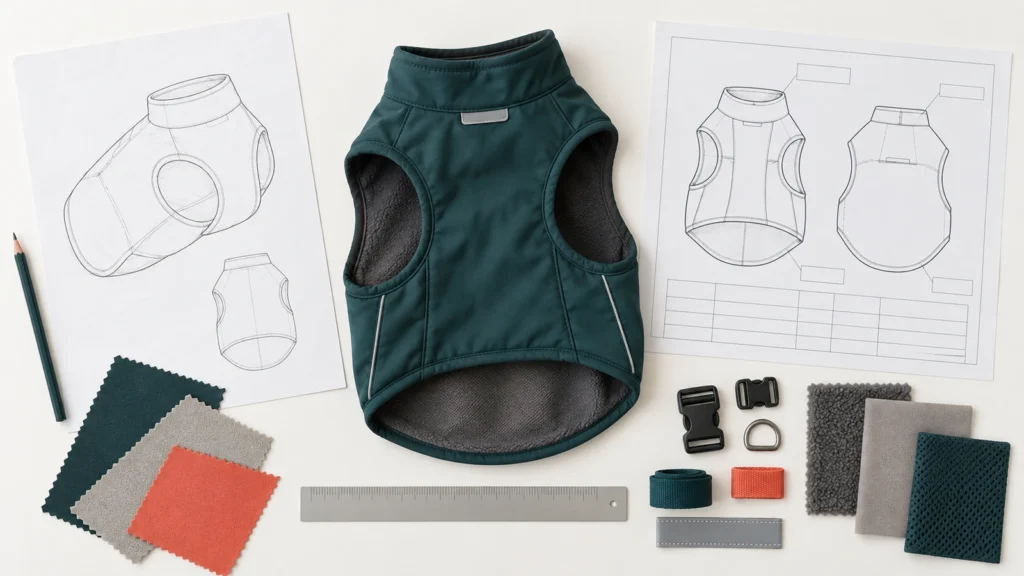
You can contact a pet apparel supplier before every technical detail is finished. Start by identifying the product you want to develop, the references you already have, and the decisions you need help resolving. The useful question is how much interpretation your project needs and which details you want to control.
A sketch communicates visual direction. A physical reference sample provides a tangible benchmark. A tech pack organizes technical instructions. Depending on the project, you may need one of these or a combination.
Do You Need a Tech Pack Before Contacting a Pet Apparel Supplier?
A complete tech pack is not a universal entry requirement for a first discussion. Supplier requirements depend on the service and project being discussed.
For example, RIGOR Apparel’s pet clothing page says it can start from a tech pack, reference sample, product photos or concept ideas. Its published process then reviews product category, fabric direction, branding and development needs before a sample quotation or project estimate.
For general apparel, NOVA’s quotation guidance accepts images or sketches alongside basic size and fabric direction, while distinguishing an opening conversation from a sufficiently defined quotation. These are supplier observations, not industry-wide rules or endorsements.
The practical distinction is between enough information to discuss development and enough agreed information to start making a specific design. Ask the supplier what it can develop from your current inputs, what is missing, and who would prepare those details. Do not assume that technical development is included simply because a supplier accepts an inquiry.
First, Define What You Want the Supplier to Understand
Use these three questions as Meetfunpet’s practical buyer framework. They help you choose the materials for the first discussion; they are not a supplier admission standard.
Are You Selecting an Existing Style or Creating a New Product?
If you want a supplier’s existing dog coat unchanged, identify its product code, link or catalogue reference. Ask for the corresponding specifications. If you want a new shape or fit, make that development request explicit instead of presenting it as a simple selection.
What Should the Supplier Copy, Change or Interpret?
Give each reference a purpose: overall proportion, material feel, closure arrangement or a particular detail. Specify what should be retained, changed or disregarded, subject to your rights to use it. A coat chosen for its fabric should not silently become the target for its fit as well.
Which Details Must Be Controlled Rather Than Assumed?
Identify non-negotiable features and measurements. Separately list decisions where you want proposals. For an unfamiliar construction detail, describe the intended result and request a technical recommendation rather than inventing a specification.
What a Sketch Can—and Cannot—Communicate
A concept sketch shows the proposed silhouette and arrangement of visible features. A technical flat drawing adds more explicit views and detail callouts. Techpacker’s commercial guidance distinguishes these drawings from the measurements, materials and construction instructions that accompany them in a tech pack.
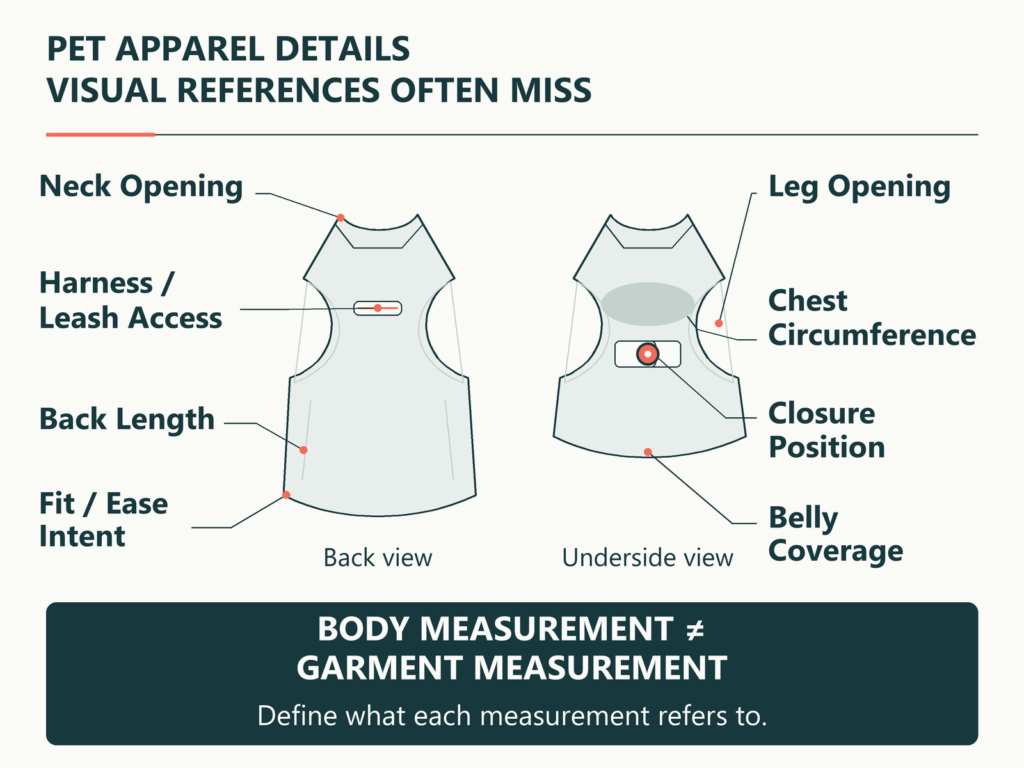
For a pet garment, show the back, side and underside wherever those views explain the design. Label the neck opening, closure, belly panel and any leash-access opening. An annotated photograph can serve a similar discussion purpose when you do not have a drawing.
A drawing without dimensions does not specify an actual opening size. A colored area does not define a fabric’s composition or stretch. A seam line does not, by itself, explain how that seam should be made. Add written instructions wherever those choices matter.
Sketches can also contain measurements and technical notes. The limitation is the information omitted, not the fact that it is drawn. An annotated sketch may become part of a larger specification package as decisions are resolved.
What a Reference Sample Can—and Cannot—Communicate
Here, a reference sample means an existing physical product used as a benchmark for fit, proportion, construction, material feel or selected details. It is not a supplier development sample, pre-production sample, approved sample or golden sample.
A physical garment lets the recipient handle the material and inspect its shape and assembly. Italian Artisan’s buyer guidance recommends identifying whether a physical reference is intended to communicate fit, fabric or finish. This is commercial development guidance, not evidence that a reference removes all interpretation.
Send written notes with the object. Identify its size, its intended role and the parts you do not want reproduced. If it has been worn or altered, explain that condition so the recipient knows what they are examining.
A single object does not communicate your intended changes or specify an entire size range. Treat an unknown fabric composition as unknown, even if its feel is useful. Ask the supplier to propose a material specification separately. The reference provides a benchmark; it does not establish that identical materials are available or that exact replication is feasible.
Use references to explain features, proportions, construction ideas or quality expectations. Owning a product does not automatically give permission to reproduce another brand’s protected design. WIPO explains that industrial design rights can restrict unauthorized commercial copying. Confirm your right to use the intended design; this is a practical boundary, not a legal assessment of a particular product.
What a Tech Pack Can—and Cannot—Communicate
A tech pack is a structured technical package for communicating how a garment is intended to be made. The Fashion Institute of Technology’s technical design learning outcomes connect tech packs with pattern development, construction, fitting and garment measurement. FIT also identifies fabric properties as relevant to development and fit.
Common sections in the descriptive guidance from Techpacker and Hawthorn’s tech pack service include:
- Style identification, date and version.
- Technical drawings and detail callouts.
- Measurement specifications, measurement locations and units; tolerances and size information where defined.
- A bill of materials covering the relevant fabrics, trims and components.
- Material and color references, construction instructions and artwork placement.
- Labels and other product details, with a record of changes.
The exact package varies. A measurement sheet is useful, but it does not contain all the material and construction decisions listed above. For the opening discussion, mark a developing pack as a draft and identify incomplete sections.
Hawthorn describes a service that starts with a questionnaire and product references, then develops the technical documentation. That is one example of obtaining development help before the pack is complete. Ask who will create and maintain your project’s specifications, what the service includes, and which files you will receive.
A detailed document still needs correct inputs and a feasibility discussion. It cannot establish by itself that the proposed garment will fit as intended or that the first physical sample will be correct.
Reference Sample vs Tech Pack vs Sketch: A Practical Comparison
This comparison summarizes the communication roles above. Read the gaps as prompts for discussion, not reasons to reject a particular format.

| Input | Best For | Communicates Well | What It Does Not Fully Define | When to Add Information |
|---|---|---|---|---|
| Sketch | Introducing a concept or showing a change | Shape, feature layout and annotated details | Unwritten dimensions, material properties and construction choices | Add measurements and notes when a visible feature needs precise control. |
| Physical reference sample | Providing a tangible benchmark | Existing proportions, material feel and inspectable construction | Intended changes, other sizes and unverified material specifications | Add a purpose label, change list and written targets before treating it as a development instruction. |
| Tech pack | Organizing technical decisions | Documented measurements, materials, construction and revisions | Open decisions, physical fit outcomes and unconfirmed feasibility | Add physical references where useful and resolve missing or conflicting instructions. |
What Should You Send for Different Pet Apparel Sourcing Routes?
The following starting points are Meetfunpet’s recommendations, informed by the sources above. Confirm the supplier’s actual requirements. Fit-sensitive development is an additional consideration that can apply to any route.
| Project Route | Starting Inputs | Details to Resolve | First Discussion Focus |
|---|---|---|---|
| Existing supplier style | Supplier SKU or product link; selected variant; explicit request for the existing specification | Relevant size chart, material and product details | Confirm that both sides mean the same product and that no design change is requested. |
| Existing style with minor modifications | Base style reference plus annotated images and a numbered change list | Placement, dimensions and affected material or fit details | Ask whether each proposed change can use the existing construction or needs further development. |
| Reference-based development | Physical reference where available; photographs; keep/change notes; known measurements | Reference purpose, target fit and material specifications | Identify what can be assessed from the reference and what must be developed separately. |
| Full custom development | Sketches or technical drawings; fit brief; available specifications or draft tech pack | Measurement definitions, materials, construction and ownership of missing technical work | Agree how the concept will become a usable set of instructions. |
| Fit-sensitive development | Relevant route inputs plus target body measurements, proportion notes and intended fit; physical benchmark if useful | Body-to-garment relationship, openings, coverage, movement intent and harness use | Identify fit questions that need technical attention before sampling starts. |
Pet Apparel Details That Visual References Often Miss
Pet apparel needs a fit brief as well as a visual direction. Hurtta’s measuring guide identifies back length, neck, chest and leg measurements. These are measurements of the dog; a development sheet should also say whether each number describes the body or the finished garment.
Define Measurements and Body Proportion
Label neck opening, chest circumference and back length, with measurement endpoints and units. Distinguish a circumference from a width measured flat. Where chest depth matters to your design, draw the intended measurement path instead of relying on the term alone. Describe the target proportions rather than asking only for a size called “medium.”
Show Coverage, Openings and Access
Mark the intended belly coverage, leg-opening positions and closure location. For a garment worn over a harness, show the required access point and identify the harness arrangement it must accommodate. Ruffwear’s Furness jacket page, for example, describes a back leash portal, neck and belly adjustment, and a particular fit. These are product-specific features, not requirements for every dog coat.
Describe Stretch and Fit Intent
State whether the proposed garment should sit close to the body, leave room for movement, or accommodate another layer. Identify the areas where stretch is intended. Ask the developer to translate that intent into material choices and garment measurements. Do not prescribe an arbitrary ease allowance simply to fill an empty field.
These prompts are a preparation framework, not a universal pet sizing system. No fixed measurement, tolerance or stretch percentage suits every project in this guide.
When Combining Inputs Works Better Than Choosing Only One
Combine inputs when they answer different questions. A sketch can show a revised belly panel; the physical reference can communicate the desired material feel; a measurement sheet can specify the intended neck opening. Together they make the request more explicit.
Give each attachment an identifier and a role. If a written dimension differs from the physical reference, state whether that difference is intentional. Resolve contradictions in the discussion rather than expecting the supplier to choose the controlling instruction.
How to Mark Confirmed Details vs Open Decisions
Use three labels in your development notes:
- Confirmed buyer requirement: a decision you want the supplier to follow, subject to feasibility confirmation.
- Reference only: a feature or material shown to explain direction, without requesting the whole item.
- Open for proposal: a decision where you want options, with any constraints stated.
Include a date and version on the note. A buyer-confirmed requirement does not mean the supplier has accepted it. Record the response and update the same working brief when the discussion resolves a detail.
Common Mistakes
- Sending a photograph without explaining its role. Add a short note about the feature it should communicate.
- Calling every alteration minor. Ask whether moving a closure or changing a material affects the development work.
- Treating a size label as a measurement. Identify the actual chart and measurement method.
- Presenting guesses as finished specifications. Label unknowns and request help resolving them.
- Sending conflicting references. Explain deliberate differences and remove superseded instructions.
A Simple Illustrative Example
Illustrative only; this is not a Meetfunpet client case. A small brand wants to develop a dog fleece vest. It has an existing garment that communicates the desired fabric feel, but wants a different underside shape and an opening for access to a harness.
A useful opening package would contain:
- Photographs of the reference, labeled “material feel only”, with the physical garment available if requested.
- A side and underside sketch showing the proposed coverage and access opening.
- Available target body measurements, with measurement locations marked.
- A note that fabric specification, garment dimensions and construction remain open for development.
The buyer can then ask whether the supplier can develop those missing specifications and what further information it needs. If the project instead uses an unchanged supplier vest, begin with that product reference and its existing specifications.
What to Send Before Your First Supplier Discussion
Assemble a compact development brief containing the route, product reference or sketch, the purpose of each attachment, known measurements and materials, requested changes, and open decisions. Add the current tech pack if one exists. Ask what else the supplier needs before quotation or sampling, and who will document the answers.
This is the product-development portion of the inquiry. For the broader order and quotation information, use the Pet Apparel RFQ Checklist.
Key Takeaways
- Choose references according to the product route and the decisions that need explanation.
- Use sketches for visual direction, physical samples for tangible benchmarks, and specifications for technical control.
- Make retained features, changes and open decisions explicit.
- Confirm who will prepare missing technical information before development begins.
Planning a Custom Pet Apparel Project?
Meetfunpet supports pet apparel development and manufacturing in China, from product requirements and sampling to private label and production follow-up. Explore custom pet apparel development with the references you already have and a clear list of the details you want to resolve.
Research Note
This guide draws on apparel technical education, commercial development guidance and suppliers’ public descriptions of their requirements. Pet product pages provide specific measurement and feature examples. Supplier statements describe those businesses’ published approaches and do not establish universal practices. The decision framework, route matrix and example are Meetfunpet’s practical synthesis. No first-party supplier-project evidence has been verified for this article.
Sources & Research References
- Fashion Institute of Technology: technical design learning outcomes; educational context.
- Techpacker: descriptive tech pack components; commercial platform guidance.
- Hawthorn: tech pack development inputs and contents; supplier service description.
- NOVA Apparel: initial quotation inputs; supplier observation.
- RIGOR Apparel: pet clothing development entry points; supplier observation.
- Italian Artisan: purpose-specific physical references; commercial development guidance.
- Hurtta: dog measurement guide; brand-specific sizing context.
- Ruffwear: Furness jacket specifications; product-specific fit and access example.
- WIPO: industrial design protection; general IP context.