
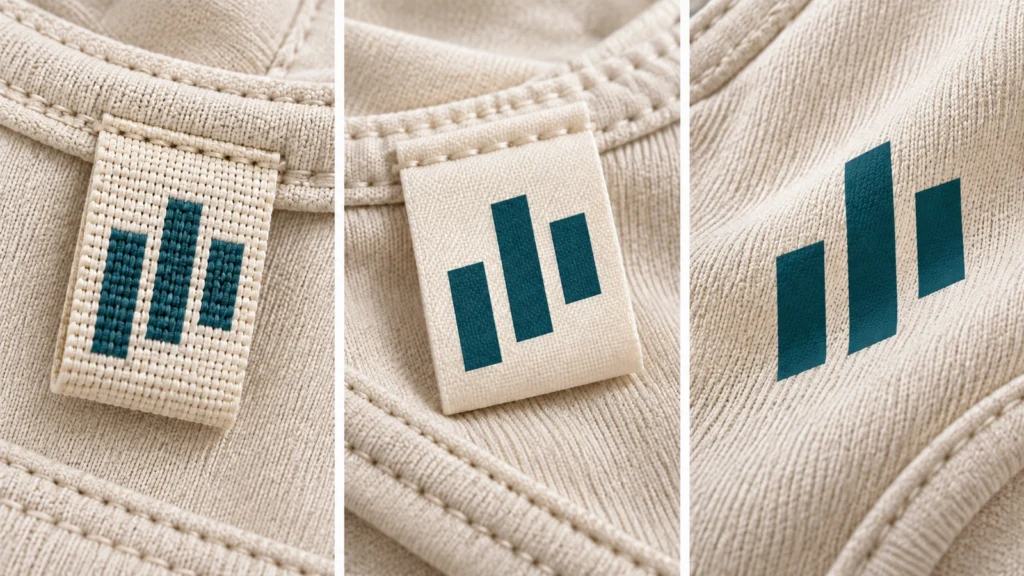
“I need my own label” is a useful opening request, but it leaves several decisions unresolved. Do you want a separate piece of fabric carrying your brand, a size identifier, care information, or a marking applied directly to the garment? Before a supplier can quote a defined scope, turn that request into a description of the information, physical label and intended position.
For pet apparel buyers comparing woven vs printed labels and heat transfer options, our recommendation is to choose by function, placement and garment compatibility before appearance alone. This is a practical decision framework, not a claim that one method performs best. Start with what the label must do, then compare feasible ways to achieve it.
First Clarify What You Mean by “Label”
Separate three questions: function means the information you need to communicate; construction means the physical label and how its design is produced; application means how it becomes part of the garment. Woven and printed fabric labels describe physical construction. Brand identification, size information and care information describe purposes or information functions. In this guide, “direct heat transfer label” means a marking transferred directly onto the garment rather than a separate fabric label.
Industry terminology overlaps. Avery Dennison’s permanent-branding portfolio lists woven labels, printed fabric labels, care labels and internal heat transfer labels together. Treat those names as starting points for clarification, not mutually exclusive boxes.
Woven vs Printed vs Heat Transfer Labels: The Basic Difference
| Method | Physical form | Information use to consider | Questions to confirm |
|---|---|---|---|
| Woven label | Separate textile label with the design formed by yarns. | Brand identity or size; other information if the approved design remains readable. | Can the actual text be woven clearly? Which fold, edge finish and attachment are proposed? |
| Printed fabric label | Separate fabric label carrying printed information. | Branding, detailed text, size or care information. | Which fabric and print process? How will readability and print performance be checked? |
| Direct heat transfer label | Marking transferred from a carrier to the garment; no separate sewn fabric tab. | Brand or size identification; other information subject to layout and product suitability. | Which transfer product, garment fabric and application conditions will be approved together? |

Both woven and printed fabric labels can be sewn into or onto garments. Some are also offered with heat-activated attachment. A heat-bonded woven fabric label is still a separate woven label; it is physically different from a direct transfer marking. Ask what remains on the garment after application.
Which Label Route Fits Your Project?
Woven Labels: Review the Actual Woven Artwork
In a woven label, yarns form the lettering or design within the label fabric. Dutch Label Shop describes different thread options and folded or flat finishes for its woven-label range. Those product choices support reviewing detail and construction together; they do not establish a universal color limit or minimum text size.
Consider woven construction when a textile brand identifier suits the design brief. Ask for the smallest letters, fine lines and reverse side to be shown at the proposed finished dimensions. If the information becomes difficult to read, compare a larger label, simpler artwork or another method. Approve the fold and sewing allowance alongside the visible area, so neither stitching nor a fold conceals text.
Printed Fabric Labels: Start With the Information Layout
Printed fabric labels carry a design printed on a fabric base. Dutch Label Shop offers printed labels with photographic detail and gradients, including sew-on options. That is evidence of its product offering, not proof that every printing process reproduces every small character successfully.
A printed option is worth requesting when several lines of information must fit a defined space. Have the supplier identify the label fabric, print process, finished dimensions and edge treatment. Review the complete text at actual size. Do not approve a large screen mockup and assume its smallest characters will remain legible on the finished label. Where two sides or multiple panels are proposed, check the reading order after attachment.
Heat Transfer Labels: Approve the Marking on the Garment
A direct transfer moves a prepared design from a carrier onto fabric using heat. CottonWorks describes the general transfer process; Dutch Label Shop’s DTF label range provides a specific label example with a removable carrier and brand or size information applied to the garment. DTF is one implementation, not a synonym for all heat transfer labels.
Consider a direct marking when your brief calls for no separate fabric tab. Still review its feel and performance on the selected garment. “Tagless” does not establish suitability for an individual pet, and this research provides no basis for an irritation-free claim. Ask the supplier to identify the transfer system and the temperature, time, pressure and peeling instructions for that product. Dutch Label Shop’s application guidance recommends trial application and notes that settings depend on the fabric.
Brand Label, Size Label and Care Information Are Different Decisions
Organize the content before choosing how many physical labels to order. Brand identification communicates the brand name or mark. Size information identifies the garment’s assigned size. Care information tells the owner how to maintain the item. Fiber or composition information describes its material content where relevant. One physical label can carry several functions, but approving the brand artwork does not approve the other information.
A care label does not identify a manufacturing technique. For example, Thermopatch’s care-label tapes include sewable materials compatible with thermal transfer printing. In that context, printing onto label tape is different from transferring a marking directly onto the garment. The words “thermal transfer” alone do not resolve the distinction.
Some information has regulatory significance, but product scope matters. In the United States, the FTC’s Textile and Wool Acts guide lists dog coats and other pet clothing among products outside Textile Act labeling coverage. The same guide explains separate coverage for wool products. This is not a blanket exemption from every labeling obligation. Labeling requirements vary by product and destination market. Buyers should verify the rules that apply to their target market.
Placement: Decide What the Finished Label Must Do
Mark the proposed position on a garment photograph or drawing. “Neck label” describes a location, not whether the label is woven, printed or transferred. For a pet garment, identify the actual panel or seam instead of copying the back-neck location of a human T-shirt.
Review the location with the garment closed and arranged as worn. Can the owner find and read it? Is a loose tab exposed? Does an edge sit at a fold or a contact point? If a harness will be worn over the garment, include that arrangement in the placement review. These are project-specific inspection questions, not a tested ranking of safe locations.
For sewn labels, specify orientation, exposed dimensions, folded dimensions and sewing allowance. Ask whether stitching should be visible on the outside. For direct markings, define the application area and orientation. Review the smallest planned garment size as well as the main sample size before adopting one position across the range.
How Garment Material Can Affect the Label Decision
A fabric name alone is insufficient for approving a transfer. Dutch Label Shop cautions that highly textured surfaces can interfere with adhesion of its DTF labels. Supply the actual application surface, including its color, texture and finish, rather than only a broad description such as “polyester.”
Thermopatch’s Truflex technical guidance conditions suitability on heat tolerance and adhesive bonding, and asks users to keep seams and closures away from the sealing area. Its FR variant also identifies water- or dirt-repellent coatings as possible bonding obstacles. These are bounded product observations, not a recommendation to use those transfers on pet apparel.
For your candidate garment, ask for checks of heat marking, surface change, adhesion, stretch behavior and readability where relevant. Compare the result on the intended color and finish. For a sewn option, assess the assembled seam, label stiffness and edge feel. Neither “cotton garment” nor “soft label” is enough to approve the complete combination.
What Changes When You Use an Existing Supplier Style?
First distinguish finished stock from a new order based on an existing pattern. Ask the supplier to photograph every current garment label and identify which would remain, be replaced or be added. Confirm whether the requested position is accessible on the finished item and whether replacement requires seam work. Review that work on the actual style.
In one Meetfunpet supplier inquiry recorded on September 8, 2026, the supplier was noted as offering woven- and care-label customization under stated order conditions. A separate supplier inquiry from the same date records a statement that buyer-supplied woven and care labels could be sewn onto garments. These are paraphrased internal inquiry records, not original full chat transcripts or verified capability evidence.
The records do not establish printed-fabric-label production or direct heat transfer garment-label capability. “Care label” does not reveal its construction, and generic customer-logo replacement does not resolve the missing method. For an existing-style inquiry, ask separately whether the supplier would source the label, accept buyer-supplied labels, apply them, or perform all of those tasks.
What to Ask Before Label Quotation
Send a label brief alongside the product reference. At minimum, include:
- The exact style or development reference, garment material information and intended market.
- Each label’s function, complete wording, language versions and size variants.
- Proposed construction, dimensions, colors, fold or edge details, and marked placement.
- Whether you supply finished labels or need the supplier to arrange them.
- Expected garment quantities by style, color and size, plus label quantities by artwork version.
- Intended washing and wear conditions, required evidence, approval responsibilities and target dates.
Identify unresolved choices explicitly. A reference photograph can show the look you want; it should not silently substitute for dimensions, wording and attachment details. The distinction between reference samples and technical specifications is useful when explaining which details are visual direction and which are confirmed requirements.
Ask the quotation to separate label supply, setup or artwork work, application, sampling and any replacement work. Confirm whether a plate, screen or other setup is required for the chosen process; do not assume all printed labels share one setup model. Request quantities by label version and garment variant, the basis of any minimum, and ownership or handling of unused labels.
The two internal label-specific statements include scoped quantity conditions. They support asking about minimums; they do not establish which method has a lower MOQ. Also request separate timing for artwork review, label manufacture, delivery to the garment supplier and application. Agree when each clock starts and how revisions affect the schedule.
What Should Be Checked on a Label Sample?
Check Appearance and Assembly
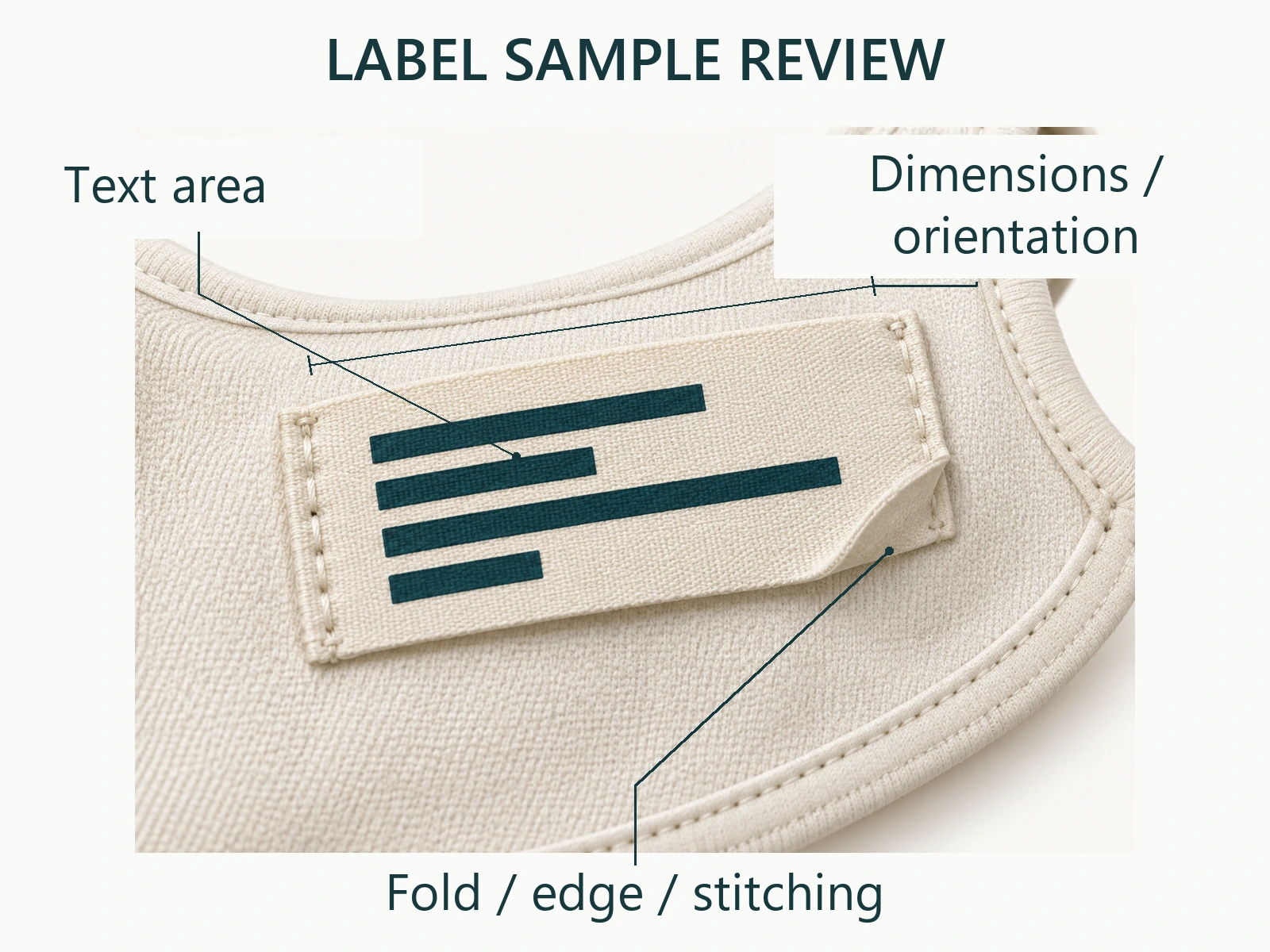
Request the intended label on the intended garment, and identify anything substituted. Check wording, spelling, size code, color, dimensions, orientation and readability. Examine both sides, edges, folds, stitching and surrounding fabric. Handle the garment to assess local bulk and feel. Record the sample’s version and the specific points approved; a photograph cannot resolve every tactile or assembly question.
Separate Visual Approval From Performance Evidence
An attractive unwashed sample does not demonstrate wash durability. For a practical wash review, agree the garment-care conditions, detergent, drying method, number of cycles and what counts as failure before starting. Inspect the label and garment afterward for changed readability, staining, edge damage, loose stitching or transfer lifting. Record observations without turning them into a longer-life guarantee.
Defined colorfastness claims require controlled testing. AATCC TM8 evaluates color transfer by rubbing under controlled conditions; its public scope cautions against some very small print areas. A laboratory should select a suitable method for the specimen. A colorfastness result is not automatically an adhesion result.
The AATCC standards directory separately identifies accelerated laundering, abrasion and quantitative fiber-analysis methods. Claims about measured laundering or abrasion performance, or verified fiber percentages, need appropriate test evidence beyond visual inspection. Request a report tied to the relevant materials and method. No method number alone proves that your finished pet garment passed.
Before bulk ordering, retain the approved artwork and sample reference, identify the materials and application process, and agree the checks for production. Define how size-label versions will be matched to garments and how substitutions or defects will be handled. A successful sample does not guarantee bulk consistency.
A Practical Label Decision Framework for Pet Apparel Buyers
Use this Meetfunpet buyer framework to organize the discussion. It is not an industry standard, compliance checklist or mandatory production sequence:
- Define the function and the exact information each label must carry.
- Choose a proposed placement and identify the actual garment surface.
- Shortlist constructions compatible with the information and intended feel.
- Clarify application, label supply responsibility and existing-style restrictions.
- Review the quotation basis, artwork, dimensions and all label versions.
- Approve a relevant physical sample and the evidence needed for performance claims.
- Confirm bulk specifications, checking responsibilities and change controls.
A Simple Illustrative Example
Illustrative only — not a Meetfunpet client case. A buyer is considering an existing lightweight dog vest. The brief calls for a small brand identifier, separate size identification and owner-facing care information. The buyer initially requests one woven label containing everything.
Instead of approving that choice immediately, the buyer asks for actual-size layouts and marks a proposed position on the vest. One candidate separates the brand identifier from a printed information label. Another combines selected information in a direct transfer, subject to the vest material and application trial. Neither option is declared the winner: readability, assembled feel, relevant performance evidence and the scoped quotation determine the next decision.
Common Label-Selection Mistakes
- Approving a “premium” or “soft” description without inspecting the specified material and edges.
- Treating a care-label offer or generic logo-customization statement as proof of a particular construction.
- Copying another garment’s information without checking product facts and destination-market rules.
- Treating a clean sample photograph as wash evidence, or sample approval as a bulk guarantee.
Key Takeaways
Define the information and placement first. Compare woven, printed fabric and direct transfer options against the actual garment and artwork. Ask for a quotation with a clear scope, approve the assembled result, and match performance claims to relevant evidence. The useful choice is the one you can specify and verify for the project.
Planning Private Label Pet Apparel?
Meetfunpet supports pet apparel development and manufacturing in China, from product requirements and sampling to private label and production follow-up. For a private label project, bring the product reference, intended label information and estimated quantities. These provide a starting point for clarifying the requirements with relevant suppliers.
Research Note
This guide separates official U.S. guidance, textile technical references, manufacturers’ descriptions of their own products, and traceable supplier statements. The buyer framework and illustrative example are editorial synthesis. No label sample, laboratory report or bulk-production result was verified in the reviewed Meetfunpet records. Complete original supplier chats were unavailable. This article does not provide legal advice or establish pet-specific comfort performance.
Sources & Research References
- Dutch Label Shop: woven, printed and DTF product pages, plus application FAQ; product-specific technical observations.
- Avery Dennison: permanent-branding portfolio; terminology and information formats.
- Thermopatch: care-label tapes and Truflex technical guidance; printing and application conditions.
- CottonWorks: heat transfer printing; general process definition.
- U.S. Federal Trade Commission: Textile and Wool Acts labeling guide; jurisdiction and product-scope boundary.
- AATCC: TM8 public scope and standards directory; test-purpose distinctions.
- Meetfunpet China Supply Validation: dated supplier inquiries from September 8, 2026; supplier statements only. Exact internal references and exclusions are retained in the Research Log.