
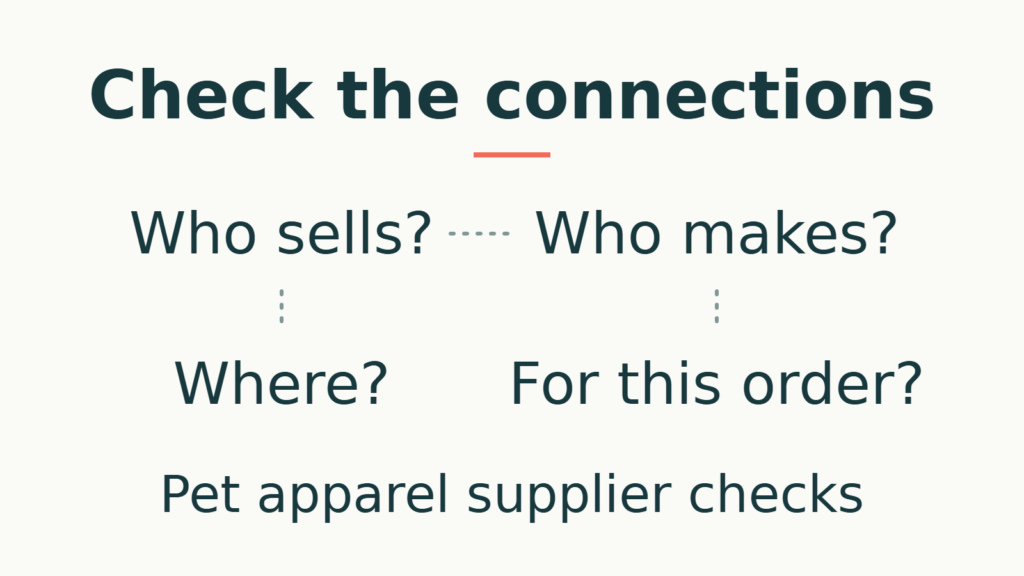
To check whether a Chinese pet apparel supplier is “really a factory,” establish who you would buy from, then connect the actual manufacturer and production sites to your order. A company registration, a workshop photo and a supplier’s explanation each answer different parts of that question.
Start with the seller’s identity, identify who will make the garments, check what the evidence covers, and record what still needs confirmation. These preliminary checks can help you ask focused questions before commissioning a fuller assessment. They can leave some facts supported and others unresolved; they do not produce a blanket “verified factory” result.
Match the company identity to the seller for your order
For a mainland Chinese company, ask for its full registered Chinese name, Unified Social Credit Code and a clear copy of its business licence. Keep the Chinese name alongside any English translation or trading name. China’s company registration rules identify the name, address, business scope and credit code among the licence fields.
Search independently through the National Enterprise Credit Information Publicity System. Official Beijing guidance on company information searches describes searching by company name, credit code or registration number and checking the company’s status. Record the source and lookup date, then compare the name and code with the supplier’s documents. For an entity registered elsewhere, use that jurisdiction’s relevant register.
Which company issued the quotation, which will accept the order, and which is named as seller in the proposed contract? Put the names beside the registration details. If different companies appear, ask what each does and what supports their relationship. If the contact’s affiliation is unclear, seek confirmation of their role through a company channel obtained and checked independently of that contact.
A registry match supports the identity fields you checked. It does not establish that the person messaging you represents that company or that the company will manufacture your garments. A manufacturing business scope, registered address or capital figure alone cannot settle those questions.
Connect the manufacturer, production sites and this order
Ask about the proposed production of your particular pet garment. A general factory introduction may leave the order’s actual route unclear. Request a short written account covering:
- Sample and bulk production: the company operating each relevant site, its full address and the work to be done there.
- Work placed with another producer: which garment processes that party will perform, where, and how it relates to the seller. Distinguish outsourced sewing or embroidery from buying ready-made components.
- Order status: which arrangements are proposed, which have been confirmed for this order, by whom, and how a change of producer or location would be notified and reconfirmed.
An office, warehouse or sample room should be identified by its function. Seeing one of them does not establish where bulk sewing will take place. A supplier’s confirmation of a planned location also remains different from evidence that production has actually happened there.
When the supplier says “our factory,” ask whether it operates the site, holds shares in the manufacturing company, or works with a separate production partner. Request evidence suited to the claim that matters: relevant company records for a claimed shareholding, or an appropriate agreement excerpt and confirmation from the named producer for a claimed production arrangement. The producer’s response can corroborate the arrangement, but it comes from a participant, not a neutral verifier.
Keep building ownership separate from operating a factory. Article 18 of the company registration rules distinguishes ownership from a right to use premises. Asking every manufacturer to prove it owns the building would therefore test a different claim from whether it operates production there.
Hypothetical example: for an embroidered dog coat enquiry, the seller says samples will be made at one site and embroidery is proposed with another company. Ask for that company’s name, the embroidery location and whether its involvement has been confirmed for this order. The label “production partner” leaves all three questions open.
The OECD’s garment and footwear guidance addresses visibility of suppliers, outsourced work and order locations when sourcing through intermediaries. Its context is responsible supply chains; here, those distinctions help frame a narrower enquiry into who will perform your order’s work.
Check whether the evidence supports that production arrangement
Now test the important claims in that account. A brochure, licence screenshot and video all supplied by the same contact remain materials from that source. Their consistency can help you compare details, but the number of files does not equal the number of independent checks.
Use photos and video to investigate specific claims
For an image offered as evidence of a production site, ask which location it shows, who operates it, when it was taken and what activity is visible. Then ask how that location relates to your proposed order. A photo of sewing machines leaves the operator and order connection unresolved.
For public images you are permitted to use, reverse image search can reveal copies worth comparing. Check the publisher, surrounding text and date clues on matching pages. If the context differs, ask the supplier to explain the specific discrepancy.
TinEye’s own tutorial explains that no results means no matches in its index; copies may still exist elsewhere. Its “oldest” sorting refers to when it found an image, not when the photo was taken. A match is a lead to investigate, not by itself proof of deception.
If a material location question remains, consider an agreed live video session or a visit with a defined scope and confidentiality arrangements. Record what you could observe and what remained out of view. Supplier-directed footage cannot independently establish ownership, all production sites, continuing capacity or future execution of your order. An area that cannot be shown remains a specific evidence gap to address through other means.
Verify the report and read its actual scope
Ask for the relevant report or document behind a badge or certificate image. Identify what it is: company verification, a facility audit, a management-system certificate or a product inspection. For example, the SGS Supplier Verification Program lists manufacturers, trading companies and service companies among its intended participants. That program’s name alone does not tell you which role a particular supplier performs.
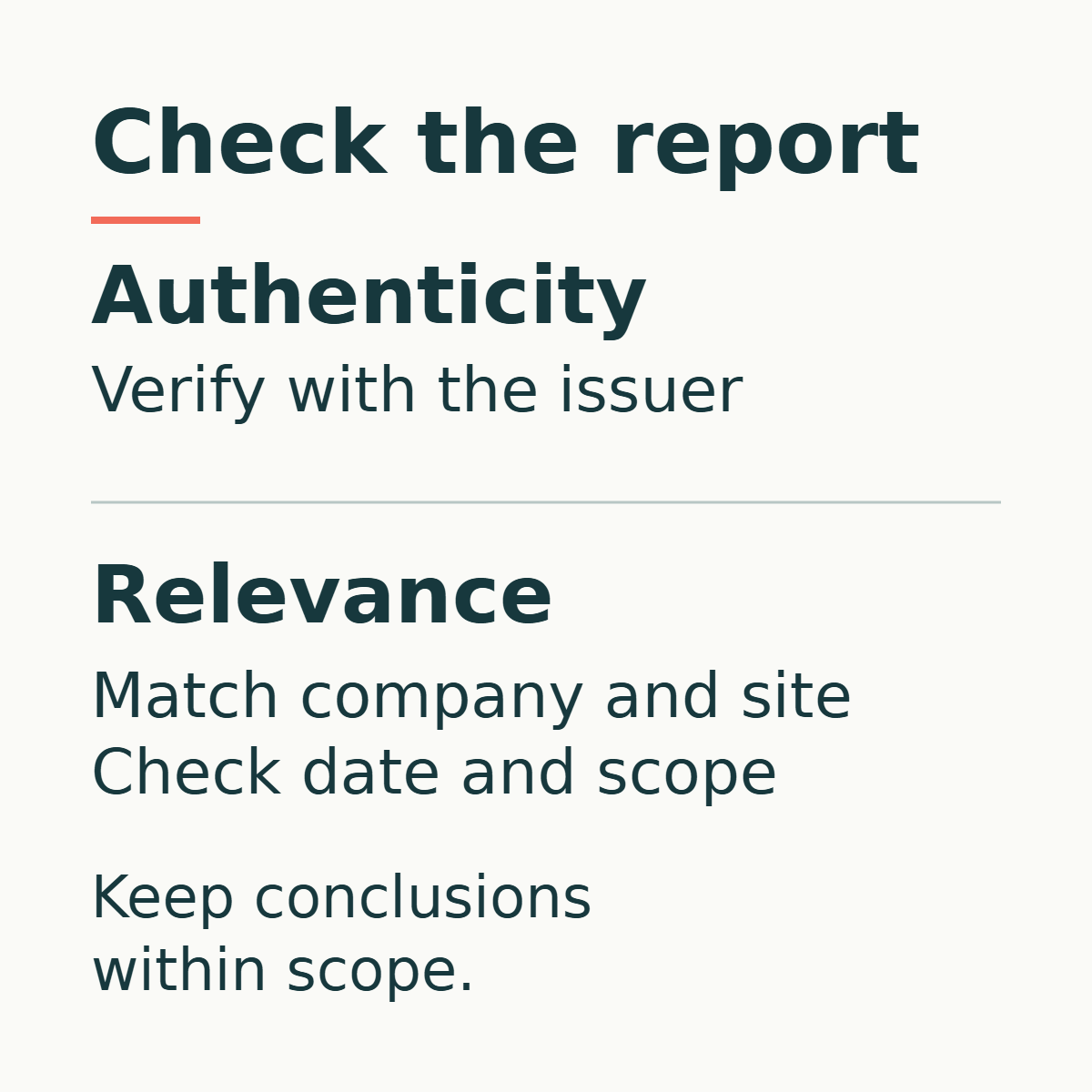
Check authenticity and relevance separately. Use the actual issuer’s appropriate verification channel, reached independently of a supplier-provided link. SGS, for example, lists separate certificate and audited-supplier verification directories. Select the route for the document type; if it does not provide a usable result, seek confirmation through the issuer’s official contact channel rather than assuming the document is false.
Compare the document’s company, site, date, activities covered and stated limitations with the production arrangement you are considering. A report for another entity or address needs an explanation and evidence connecting it to the relevant claim. An older report raises a question about what has changed; there is no single age limit proposed here for every document type.
A product inspection and a facility assessment answer different questions: Intertek’s apparel inspection description distinguishes product and workmanship checks from auditing facility procedures and systems. Even an authentic report supports only its stated findings and scope. It does not automatically establish ownership, cover an unlisted site or prove that your order will be made there and meet its quality requirements.
Record what is supported and what needs another check
Keep a short record for each fact your next decision depends on: the claim; supporting material, source and date; the unresolved point; and the next action. New Zealand Government Procurement’s due diligence guidance calls for independent verification and documented checks in its public procurement context. This narrower record applies that discipline to supplier identity and production relationships.
- Identifiers are missing or inconsistent: obtain the relevant company details and compare them with an independent registration source.
- The company matches, but the operator or relationship is unclear: seek evidence for that specific link, using independent corroboration where the decision requires it. A premises-use record, company ownership record and order-specific production confirmation serve different purposes.
- A material contradiction remains: pause the decision that depends on it. Specify who will obtain what evidence and when the issue will be reviewed. A targeted site, ownership or legal check may require separate specialist work.
If relevant information is confidential, discuss restricted disclosure or suitable alternative evidence. Where the necessary information remains unavailable, keep the gap open. Revisit affected conclusions if the producer or production site changes.
Use that record to choose the next enquiry. For the broader question of product and project fit, continue to evaluate a pet apparel supplier for your project. If you are discussing pet apparel development and manufacturing with Meetfunpet, How We Work provides the starting point for discussing your project’s development and production arrangements.