
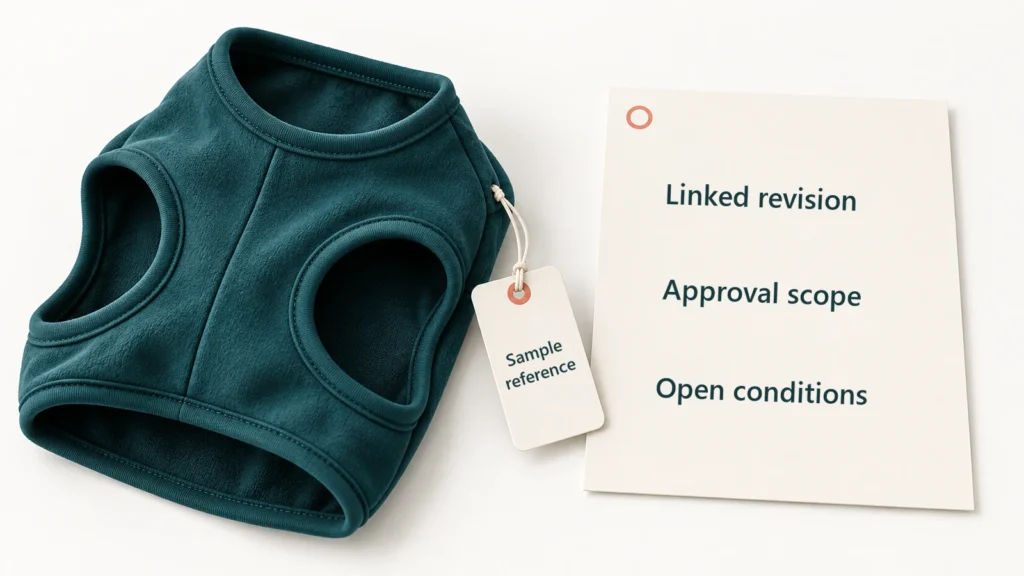
Before relying on a sample as an approved production reference, confirm which physical item and specification version were accepted, what the approval covers, what work it permits, and how unresolved conditions or later changes will be reviewed. This is Meetfunpet’s proposed decision framework for pet apparel buyers, adapted from apparel and quality-assurance sources. It is not an industry standard.
Here, an approved sample means a specific sample accepted for a stated scope. Its use as a production reference must be clear in that decision. A satisfactory-looking sample, or an “approved” message without that context, leaves important questions unanswered. The reference also does not guarantee the quality of subsequent bulk production.
Five Decisions Before Using a Sample as a Production Reference
- Identify — Which sample was actually approved?
- Link — Which agreed specification version belongs with it?
- Define scope and next step — What exactly was approved, and what work may proceed?
- Record conditions — What is still not approved or still needs correction?
- Review changes and current reference — What has changed, and which reference now applies?

Identify the Physical Sample
A style number identifies the design, but may not distinguish several rounds of the same sample. Give the reference an identity that the buyer and supplier can both trace to the physical item.
Useful details include the style or SKU where applicable, sample type, sample ID, round or version, size, colour, sample date and where it was made. Record who holds the reference and how any corresponding copies are identified. These are suggested fields; agree the identification method for your project.
Techpacker’s garment fitting guidance checks the received sample’s type, style, size, colour and material information against its accompanying records. Ask: could someone who missed the review still find the exact item that the decision refers to?
Link It to the Agreed Specification Version
The physical sample needs its supporting instructions. In its 2023 vendor quality manual, J.Crew reviews pre-production samples alongside technical documentation. This is a brand-specific example of a principle buyers can adapt: read the accepted sample and its related records together.
Link the relevant specification revision, measurement sheet, construction notes, material or bill-of-materials reference, colour reference, artwork revision and change comments. Include what applies to the approval scope; the list is not a fixed document requirement for every product.
A saved or newly sent revision is not, by itself, evidence of approval. Record which version was accepted. If the physical sample and a later document disagree, identify the difference and ask the person authorised to approve the order which instruction applies. Do not silently assume that either the newest file or the physical sample takes priority.
For the roles of these development inputs, see Reference Sample vs Tech Pack.
Define the Approval Scope and Next Step
Record the accepted attributes and the permitted next step separately. Acceptance of fit, appearance or one size does not automatically authorise bulk production or settle every other quality question.
Identify the person approving, their role, the approval date and the decision record. State whether the decision accepts a particular feature, establishes a production reference, permits another development sample or authorises a specified production step. Keep the sample’s making or receiving date separate from its approval date.
The Wearables procedure in PCHI’s 2024 vendor manual distinguishes approval stages and the work they permit. It supports asking what a decision authorises; it does not supply a universal release procedure for pet apparel.
If fit is part of the accepted scope, identify the sample and review record supporting that decision. Pet Apparel Fit Testing Before Bulk Production addresses the observation and revision work behind it.
Record Conditions and Unapproved Items
An approval record can become misleading if its conditions are separated from the sample. InTouch’s guidance on approval samples describes references accompanied by corrections that the inspector needs to know about. That does not establish permission to produce with unresolved defects.
We suggest separating open information into three categories:
- Accepted deviation: a stated difference that the authorised person has explicitly accepted within a defined scope.
- Correction still required: a change remains due; identify who will make it and what evidence will confirm completion.
- Not reviewed: the item has no acceptance decision yet; do not absorb it into a general approval status.
For each unresolved item, record its owner, required evidence, closure condition and timing, and who will confirm closure. Ask explicitly what work may proceed while it remains open. “Approved with changes” should not be interpreted as permission to cut bulk unless that permission is established for the order.
Review Changes and Confirm the Current Reference
A change may leave the old reference incomplete for the affected part of the product. PCHI’s 2024 Wearables procedure requires new sample review for significant changes involving materials, design, construction or production processes, and for factory changes. Those are requirements in that specific procedure, not universal thresholds for your order.
When a change is proposed, use the original approval scope to frame the review:
- Material substitution: does the replacement affect an attribute accepted on the original sample?
- Trim: does the changed component alter accepted material, appearance or construction?
- Construction: which approved detail is different?
- Measurement or specification: does the revision affect the accepted size or fit scope?
- Colour: does the existing colour approval cover the proposed version?
- Artwork or branding: which revision was accepted, and what has changed?
- Factory or process: what confirmation is needed before relying on a reference made under the previous conditions?
These are review questions, not automatic demands for a complete replacement sample. Ask the project’s authorised approver to determine the affected scope, the evidence needed and the work permitted while the change is reviewed. Depending on that decision, confirmation may involve documents, evidence for a particular detail or a revised sample.
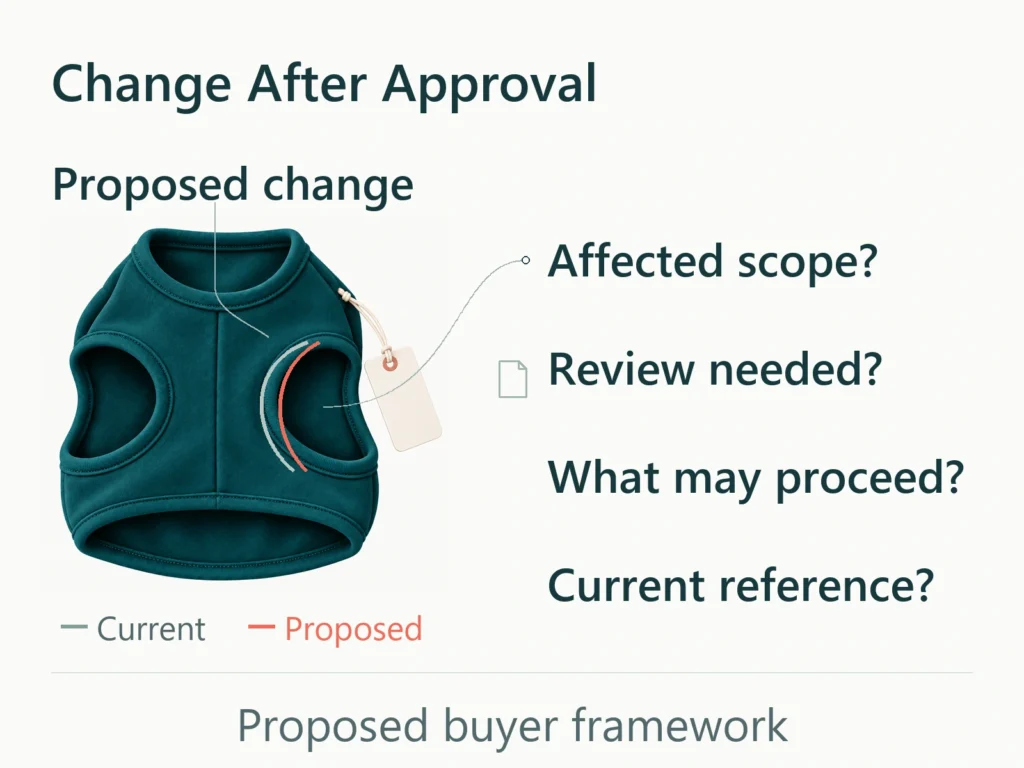
Identify the current reference and which earlier decisions still apply. Link the applicable files and record what has been replaced. InTouch’s inspection-preparation guidance recommends sharing revised specifications and their differences. Make those changes clear to the people using the reference.
What Do “Golden,” “Sealed,” and “PP” Actually Tell You?
The reviewed sources use these labels in different contexts. Confirm the sample’s role and approval scope rather than relying on its name.
| Term | What it may describe | What the buyer still needs to confirm |
|---|---|---|
| Golden sample | In InTouch’s inspection guidance, an approved comparison sample. | Which item, attributes and conditions were accepted? Confirm that your supplier uses the term in this sense. |
| Sealed sample | Techpacker describes a sealed approved PP sample; InTouch also describes sealing defect samples for retention. | Why was this item sealed, and what is its approval status? A seal alone does not establish acceptance. |
| PP sample | A pre-production sample type or stage in the reviewed apparel procedures. | Has this particular sample been approved? Confirm its making conditions, scope and permitted next step separately. |
These distinctions draw on Techpacker’s garment sample guide, InTouch’s approval-sample guidance cited above, and its sample-sealing guidance.
What Sample Approval Does Not Establish
Keep each conclusion within the evidence actually reviewed. The source procedures distinguish different review tasks: Techpacker discusses fit, size-set and performance-test samples separately, while J.Crew’s 2023 manual retains production and shipment checks after PP approval.
- One accepted size does not establish an unreviewed size range. Identify the sizes covered by the decision instead of extending that record to other sizes.
- A reference approval does not guarantee bulk consistency or approve every production unit. It establishes a comparison reference; later production output is a different object of assessment.
- An appearance approval record is not evidence of testing or certification that it does not cover. This is a limit on what the record proves, not a conclusion about compliance with any particular certification scheme.
- Fit acceptance does not automatically include every quality attribute. Keep other attributes tied to their own review evidence and decisions.
A separate quality checklist before bulk approval addresses the checks needed beyond reference governance. The approval record here helps identify the applicable decisions and evidence; it does not replace that broader assessment.
What to Record Before Relying on the Sample
Use this proposed record structure as a buyer checklist when confirming the reference with your supplier. Keep the entries specific to the order and link to supporting records where needed.
| Record group | Information to identify | Open question or follow-up |
|---|---|---|
| Physical identity | Sample ID, style, type, round, size, colour, sample date, making source and holder. | Can everyone locate the same item and identify corresponding copies? |
| Linked records | Relevant specification and supporting revisions, with approval comments. | Which versions were accepted? Who will resolve any conflict with the sample? |
| Scope and next step | Accepted scope, permitted work, approver and role, approval date and decision record. | Does the decision explicitly permit the work being planned? |
| Conditions | Accepted deviations, required corrections, unreviewed items, owners, closure evidence and timing. | What remains open, who confirms closure, and what work can proceed meanwhile? |
| Current reference and changes | Change record, affected scope, review decision, current sample/file versions and replacement relationships. | Do the people using the reference know which earlier instructions still apply? |
Bring any unanswered entries to the person authorised to make the approval decision. Completing the record makes that decision traceable; it does not itself authorise production or prove that the order meets every quality requirement.